



Fi Europe 2026: GLP-1 needs and personalization drive fiber and protein innovations
Key takeaways
- Needs of GLP-1 patients and personalization are driving innovation in nutrition, with exhibitors presenting high-fiber and high-protein concepts at Fi Europe 2026.
- ADM said that reformulation is speeding up due to the use of AI, GLP-1s, and regulation, while Ingredion said demands are shifting from low-sugar to benefit-led products.
- Prinova presented a clear protein drink, Valio highlighted how hydrolyzed lactose can support sports recovery, and Bioiberica presented collagen in functional food and beverage formats.


At Food Ingredients (Fi) Europe 2026 (Nov 17–19) in Frankfurt, Germany, food and nutrition ingredients companies presented their latest innovations and product concepts for healthier, nutrient-dense foods.
On the show floor, Nutrition Insight met with Valio, ADM, Prinova, Ingredion, and Bioiberica to discuss how GLP-1-related nutritional needs and personalization are driving demand for high-fiber, high-protein products in functional food and beverage formats.
Sinikka Saikkonen, senior business development manager at Valio, highlighted several topics shaping consumer needs in dairy and nutrition.
“First, consumers expect more per bite. They want to maximize the nutrients and health benefits they obtain from the food they buy and eat, so they’re very careful to choose food and drinks that are really worth it.”

“Second is getting enough high-quality protein,” she added. “In consumers’ minds, the focus is moving beyond protein quantity to protein quality. Dairy offers a good opportunity here, because it contains the most complete protein.”
A third consumer demand Saikkonen pointed to is a need for sustained energy. She noted that consumers lead busy lives and need sustained energy to keep going throughout the day.
Bastian Hörmann, senior marketing director at ADM, added that anti-obesity medications such as GLP-1 therapies are driving personalized nutrition due to the needs of people taking these drugs.
“They need to retain muscle, so they need a higher protein intake as they lose body fat and weight. They need to stay hydrated, which can be hard because drinking water makes you feel full, and in general you feel fuller faster.”
He said that supplements to support the body are a “huge space,” such as fiber for digestive health for consumers during or after GLP-1 medication.
“That’s where food and beverage companies are reformulating, or I’d even say renovating, their products toward those needs and more functional, personalized nutrition: high in fiber, high in protein, and of course lower in sugar and calories,” Hörmann detailed.
 ADM’s Zoe Marshall-Jones told us that postbiotics are gaining attention in pet health due to their stability.“Convenience also matters, such as products that are easy to prepare and come in smaller portions. Those are the big topics at the moment.”
Rate of reformulation
ADM is observing a change in the pace of reformulation, said Hörmann. He pointed to several trends driving this speed, such as consumers demanding more personalized nutrition, higher protein, and added fiber, with GLP-1 medications and social media influencing innovations and product launches.
“That’s changing the pace of innovation,” said Hörmann. “In past years, 18 months might have been an average innovation cycle for a product. Now there are predictions that this will shrink to a few weeks, partly because of what we can use AI for: formulation development, testing, and learning.”
He also said government regulations, such as sugar taxes, are changing the pace of reformulation as these help create new nutrition products.
“Nutrient density is of high importance,” underscored Hörmann. “That’s why reformulation needs to accelerate, so we can help customers and consumers get what they need. Those needs are much more specific than in the past, which is another reason the pace is changing.”
“Fi Europe and this environment help create new innovations faster. The exchange between companies at the venue also helps everyone understand future consumer needs. With the conference theaters and insights from data and industry partners like Innova Market Insights, it all comes together to understand the bigger picture.”
Personalized nutrition
Prinova leveraged the personalization trend at Fi Europe 2026 with the theme “Your Way.” The company presented a clear protein beverage, nutrient-dense options for GLP-1 users, and a high-protein coffee.
Michael Robbins, technical sales executive at the company, said their theme builds on the personalization trend that Prinova has seen increasing in food and beverage over the last two to three years, particularly in nutrition.
“Consumers want products that are personalized to them but also offer a tangible health benefit,” he detailed. “Products need to be very clear about what they do so consumers understand them. They also need to target consumers’ health needs and the trends they care about, because there’s no point having a product that consumers aren’t interested in.”
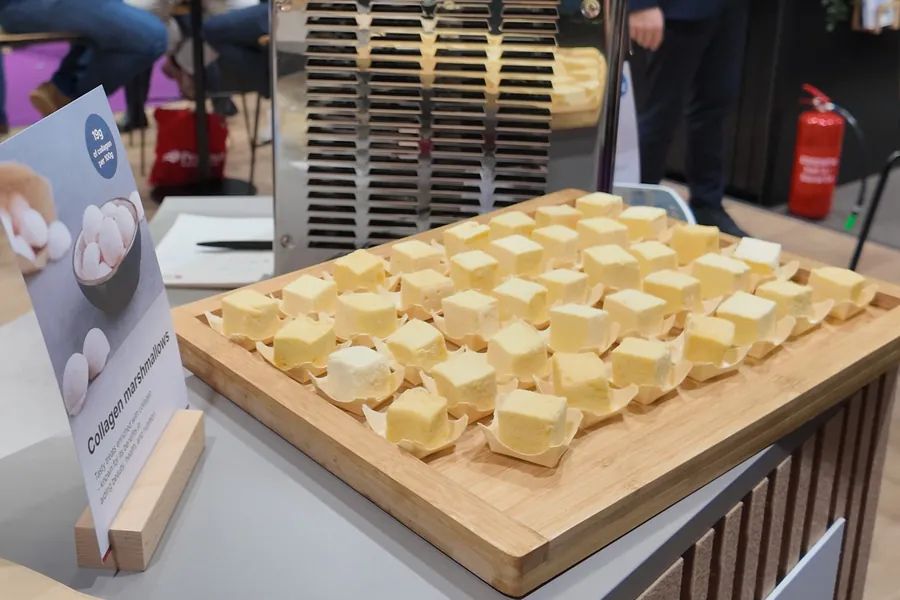 Essentia Protein Solutions presented collagen marshmallows enriched with OmniCol, the company’s bovine collagen peptides.“This year, we picked out the key trends we believe in: added or high protein, and added or high fiber. Both categories have exploded over the past 12 months,” said Robbins.
Meanwhile, Innova Market Insights data indicates that global protein-based ready-to-drink launches grew at a 50% CAGR between July 2021 and June 2026. Between April 2021 and March 2026, sports nutrition and supplement launches featuring fiber grew 11% annually.
Robbins said that this consumer interest “gives brands a clear white space.” He also noted that potential is not limited to targeted areas such as sports nutrition. “It’s much wider and much more mainstream.”
Protein innovations
According to Robbins, demand for clear protein drinks has accelerated as the trend combines added protein with a shift in consumer preferences. Prinova presented a clear pea protein soda flavored with peach and ginger at the show.
“Consumers are moving away from the typical high-protein, milk-type ready-to-drink beverages that dominated the category for years,” he said. “They want something juice-like and refreshing, something they can drink throughout the day, especially in warm summer months.”
He also noted that protein becoming an everyday staple is another growth driver. “More consumers are thinking about their protein intake and want a convenient option that suits their taste.”
Robbins pointed to flavor innovation as another driver for clear and juice-like protein drinks, as these offer “more room to be creative.”
Prinova’s “Joe Gains” high-protein coffee concept at Fi Europe 2026 featured Essentia Protein Solutions’ OmniBroth broth powder. Robbins said this concept adds functionality and puts a spin on the high-protein trend. “It isn’t just about building muscles for people who play sports. It takes a more holistic, well-being approach.”
“Bone broth powder has a very high collagen content. That opens the product up to consumers interested in longevity and, with the high collagen content, joint health,” he added.
Sports recovery
Valio presented a post-exercise recovery drink concept with hydrolyzed lactose. This lactose-free beverage combines milk protein with carbohydrates derived from milk sugar to support muscle recovery and energy replenishment.
 Arla Foods Ingredients presented a range of GLP-1 dairy concepts at Fi Europe 2026, including a 20% protein shot.Saikkonen said the company conducted a study to compare the drink with a conventional, commercially available recovery drink whose carbohydrates are based on maltodextrin and glucose.
“Our hypothesis was that hydrolyzing lactose into glucose and galactose would make the recovery effect comparable to conventional products containing only glucose-based carbohydrates,” she explained. “Our hypothesis was correct.”
Valio conducted the pilot study with the University of Turku, Finland, she added. The teams measured the recovery of strength and endurance through physical measurements. Saikkonen said the results were “exactly the same” for both products.
“So, hydrolyzed lactose is a viable alternative to recovery drinks based on maltodextrin and glucose, with the same, comparable effects on performance.”
Saikkonen explained that the carbohydrates in hydrolyzed lactose are easily used by the body. “They restore energy stores in both the muscles and the liver.”
“Hydrolyzed lactose also offers gut comfort. People with lactose intolerance or a sensitive stomach won’t get symptoms from lactose-free products.”
From sugar reduction to fiber forward
Ingredion’s Sue Bancroft, director of healthful solutions EMEA, said that over the last five years better-nutrition products have moved from a focus on sugar reduction, weight management, and a healthy glucose response to lower sugar becoming “almost the baseline for a nutritional product.”
“People are asking how to enhance a product’s benefits: ‘I don’t want sugar; I want the best-tasting product without sugar, but what will it do for me?’ The focus has moved to the outcome of consuming the product,” she detailed.
Bancroft said that a “huge amount” of new product development focuses on the end benefits of products.
“That’s why we’re seeing more inclusion of fiber and protein, and in some beverage areas, added vitamins. We’re also seeing collagen beverages,” she explained. “We call it ‘beverages with benefits’ — the same applies to foods.”
Ingredion presented a no-added-sugar gut health soda concept at Fi Europe 2026 that is a good source of fiber, said Bancroft. “We know consumers understand what fiber does for them. If a product is high in fiber or a source of fiber, people associate it with the benefits they understand fiber provides.”
“We’re getting a lot of questions about fiber here at the show. I think that’s because of the launches of gut health sodas, which have almost created a new carbonated soft drink category.”
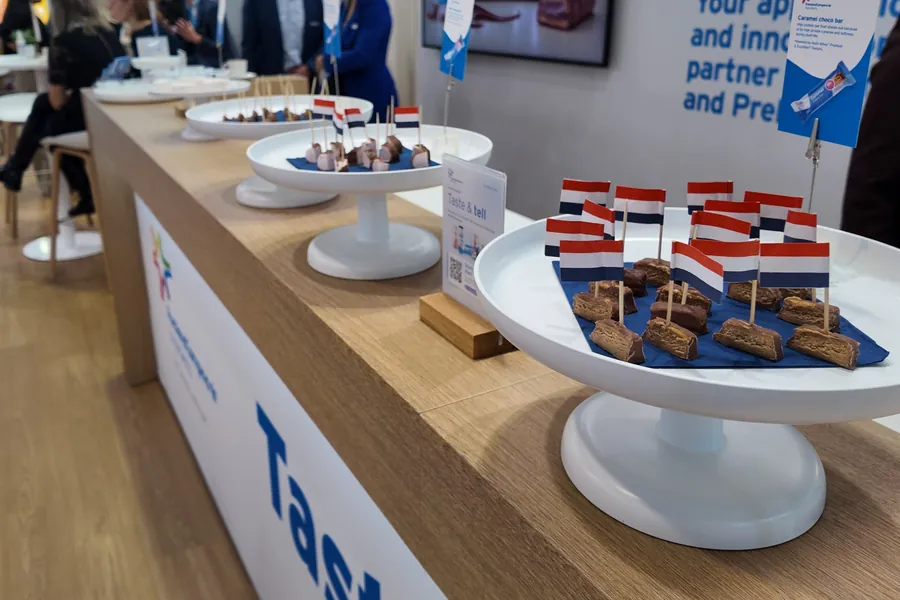 FrieslandCampina Ingredients presented Melo and Caramel bars that combine protein with texture and enjoyment.She underscored that fiber is opening up new consumption occasions. For example, she said these gut health sodas provide an alternative drink to alcohol or low- and no-alcohol options.
“Soluble fiber is really important now,” Bancroft added. “We also have a resistant starch fiber that’s being used in foods such as breads and cereals, and we have a tortilla wrap with protein and fiber. We’re seeing more of those combinations.”
“Fiber will be very complementary to protein, and probably essential,” she predicted.
Functional formats
Bioiberica exhibited at Fi Europe for the first time this year, which it said “reflects the growing importance of functional foods and beverages in empowering the health evolution.”
Antonio Vendrell, marketing and communications director at the company, added that this category is growing fast. “Populations across all ages are looking for health benefits in their food.”
“Functional food has been on the market for a while, but given the strong momentum we’ve seen lately and expect in the future, it makes a lot of sense for Bioiberica to play a role in these formats, with our portfolio in mobility, muscle health, beauty, and digestive health.”
“Nowadays, people don’t only look for health when they have an illness or a problem — they look for it even when they’re healthy,” he added. “They want to prevent problems and stay in good shape. It’s part of their lifestyle, and that’s why we see this clear trend in functional food and beverages.”
At Fi Europe 2026, the company presented carbonated juice and bone broth featuring its native type II collagen, Collavant n2, as well as beverages and gummies with Dermial, a hyaluronic acid matrix ingredient for beauty. In January 2026, Bioiberica and Lactalis Spain launched a collagen-enriched milk for joint health.
“Functional food, particularly with ingredients such as collagen or specific hyaluronic acid matrices, is something we see growing across age groups and countries,” said Vendrell.
“This has been an evolution,” he added. “Bioiberica began as a pharmaceutical company and has expanded into different health areas. Today, we have a strong division in branded ingredients for dietary supplements, and we’re now moving toward functional food.”