



Researchers find modest changes in food purchases after GLP-1 use


Key takeaways
- Danish research reveals that GLP-1 users spend less on food, with a notable reduction in calories, sugar, saturated fat, and carbohydrates.
- Participants on GLP-1 drugs showed a small increase in protein purchases and a modest reduction in ultra-processed food consumption.
- The study indicates that even small dietary changes could accumulate at the population level as the medication becomes more widely accessible.

Analysis by Danish researchers reveals that new GLP-1 users spent less on food supplies and purchased fewer calories, sugars, saturated fats, and carbohydrates, while modestly increasing protein purchases. The share of ultra-processed foods in total shopping also decreased.
The team analyzed supermarket receipts from 1,177 participants in the Health, Food, Purchases and Lifestyle (SMIL) study, including 293 people who initiated GLP-1s during the study period.
People taking these medications decreased their average energy intake by 2.1 kcal/100 g, sugar intake by 0.6 g/100 g, carbohydrate intake by 0.5 g/100 g, and saturated fat intake by 0.1 g/100 g. Meanwhile, protein increased by 0.3 g/100 g.
“Although modest at the individual level, these changes may accumulate at the population level, particularly given increasing GLP-1 use,” details the research.
Food purchases
In their research letter in JAMA Network Open, the authors note there are few papers on the impact of GLP-1 use on food purchases, aside from case reports and small observational studies.
The team selected 293 participants in the SMIL cohort who started GLP-1 medications and 884 people who did not use the weight-loss drug but were matched for sex, age, and income.
Participants in the study collected shopping data through a mobile app. The researchers analyzed over 800,000 purchases made by consumers before they started the medication and more than 1.17 million purchases after they started GLP-1 therapies.
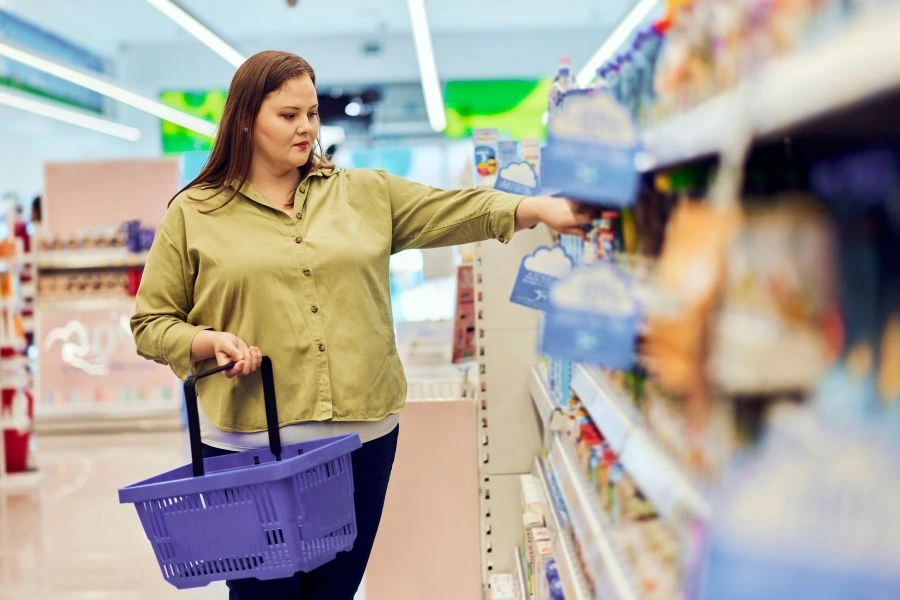 In their first year, new GLP-1 users spent less on food, with fewer calories, sugar, saturated fat, and carbohydrates, while increasing protein purchases.On average, participants spent DKK52,523 (US$8,373) on food in the year before starting the medication and DKK35,051 (US$5,589) after GLP-1 initiation.
After starting the medication, participants also spent a larger share of their shopping on unprocessed foods (0.9%) and a smaller share on ultra-processed foods (-1.2%).
Study limitations
The researchers also highlight several limitations. They note that the participants likely reflect a “self-selected group” willing to share supermarket receipts.
Moreover, the team lacked access to body mass index data, which could affect the study results, as observed changes may reflect the start of a weight-loss journey.
Although the study included a small number of participants, the authors say their analysis was strengthened by the large volume of food purchase receipts.
The team categorized individual food items into nutritional groups using an algorithm. The authors say they cannot rule out potential misclassification during item matching. However, this would affect analyses equally before and after starting the medications, as they used the same categories for both, suggesting minimal systemic bias.
Nutrition for GLP-1 users
US nutrition and health experts predict that the expansion of GLP-1 medications will make the “most significant impact in 2026.” These drugs are expected to become more accessible to consumers due to lower prices and more convenient delivery formats, such as pills.
Amid their rising popularity, experts also identified eight nutritional priorities last year to support these therapies, including management of gastrointestinal side effects, personalized diets, and prevention of micronutrient deficiencies. The experts highlight that nutritional strategies are pivotal to addressing challenges around GLP-1s.
Earlier this year, Nutrition Insight also explored opportunities and challenges for innovation in the food industry, while we looked at products from start-ups in nutrition and pharmaceuticals that support GLP-1 users.