



Only two of 104 UK children’s yogurts are low in sugar, Action on Salt & Sugar finds


Key takeaways
- Action on Salt & Sugar found that only two of 104 UK children’s yogurts surveyed were low in total sugar.
- Average sugar content was 8.2 g per 100 g, ranging from 4.7 g to 14.1 g per 100 g.
- Campaigners say voluntary reformulation is too slow and call for mandatory sugar targets and tighter rules on child-appealing packaging.

Action on Salt & Sugar has found that only two out of 104 children’s yogurt products surveyed in the UK were low in total sugar levels. The group argues that voluntary industry actions and policies are insufficient in lowering sugar content in foods, urging the government to make healthier options more available and affordable.
According to the UK National Health Service, a food is low in sugar when it contains 5 g of sugar or less per 100 g.
Action on Salt & Sugar’s results show that sugar content in children’s yogurt ranges from 4.7 g to 14.1 g per 100 g. Although the average sugar content levels in this space have decreased by 11% since 2021, the advocacy group says progress is inconsistent and too slow.
The organization also criticizes the prevalence of the products’ marketing and colorful packaging. Local health groups have previously called for mandatory reformulation goals and stricter advertising regulations.
Against this backdrop, the Recipe for Change campaign underscores that 79% of UK adults believe that government intervention is necessary, stressing that public trust in food companies to reduce unhealthy ingredients is low.
Sugar contents
The Action on Salt & Sugar survey of 104 children’s yogurts found that the average sugar content was 8.2 g per 100 g. Nestlé Smarties Vanilla Split Pot yogurt was highlighted for having the highest amount — 14.1 g per 100 g — nearly four teaspoons of sugar per serving (15.1 g).
In contrast, The Collective Great Dairy Natural + Vitamin D and Yoplait Petits Filous No Added Sugar Strawberry & Banana contained the least amount of total sugars at 4.7 g per 100 g, the survey finds.
It also found that Nestlé yogurts had the highest total sugar content per 100 g at 10.7 g, followed by Lidl at 9.4 g and Aldi at 9.0 g. Sainsbury’s products were noted to have the lowest average at 6.2 g, followed by Yeo Valley at 6.8 g.
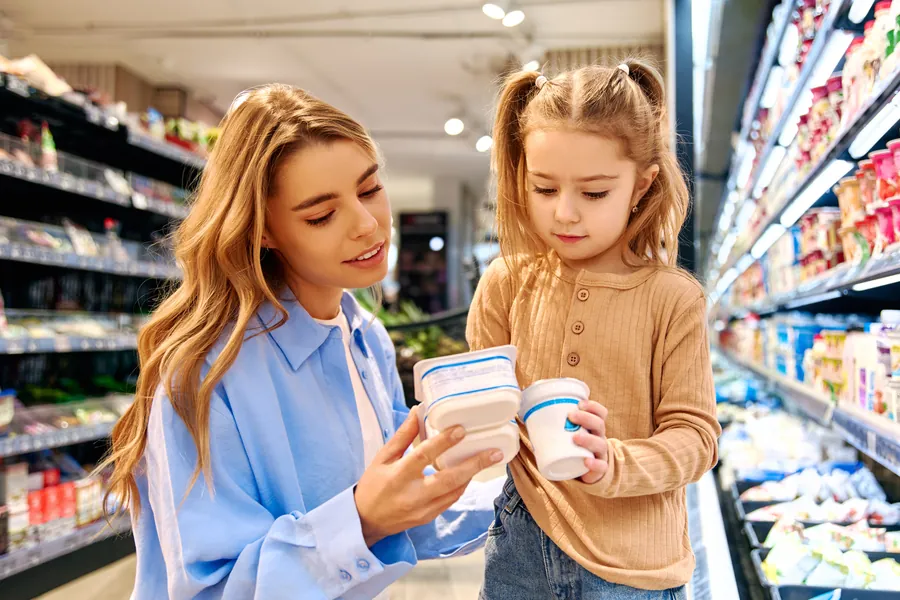 Action on Salt & Sugar’s results show that sugar content in children’s yogurt ranges from 4.7 g to 14.1 g per 100 g.Action on Salt & Sugar explains that the research factored in naturally occurring sugars from milk at 3.8 g per 100 g of total sugars. After accounting for this, the authors maintain that children’s yogurts mostly contained free sugars, which research has found to be harmful to health.
“Yogurt can be a valuable source of nutrients such as calcium and vitamin D in children’s diets, but these should not come with unnecessary amounts of free sugars. Parents should not have to choose between providing nutritious foods and avoiding excessive sugar in products specifically marketed for children,” comments Dr. Kawther Hashem, head of Research & Impact at Action on Salt & Sugar, based at Queen Mary University of London, UK.
Call for food innovation
The UK government’s 2016 voluntary Sugar Reduction Programme has made slow progress, with some manufacturers showing that significant sugar reduction is possible, highlights Action on Salt & Sugar.
The program aimed for a 20% reduction in total sugar by 2020. However, Action on Salt & Sugar points out that yogurts reduced sugars only by 13.5% between 2015 and 2020.
Furthermore, it notes that though sugar restrictions have been introduced in some kinds of advertising for F&B high in fat, salt, and sugar, there are no such rules against using child-appealing packaging for unhealthy products.
“Some companies have shown that reductions in sugar are possible, proving that reformulation can be achieved. However, progress remains inconsistent and far too slow because it relies largely on voluntary action,” says Hashem.
 Nestlé yogurts had the highest total sugar content per 100 g at 10.7 g, followed by Lidl at 9.4 g and Aldi at 9.0 g.“Parents could reasonably expect products covered in cartoons and specifically marketed to children to be among the healthier options available, but our findings show that is often not the case. The government must introduce stronger measures to ensure all companies reduce sugar levels and that child-appealing packaging is reserved for the best products out there.”
Kate Howard, Children’s Food Campaign coordinator at Sustain, adds: “Food companies are highly innovative when there is a commercial incentive, and that same energy should be directed toward making healthier food the easy and affordable choice. Industry may point to rising costs and global pressures as reasons to resist change, but clear and consistent rules benefit everyone, including responsible businesses.”
Healthy food challenges
A campaign by Recipe for Change found that 60% of Britons find eating well to be difficult today, with 47% finding it harder to eat a balanced diet than 20 years ago, and 13% saying it was difficult then and now.
Action on Salt & Sugar underscores that its findings support the Citizens’ Charter from Recipe for Change, which urges UK ministers to take a stance against large food companies, bolster regulation, and make healthy food more affordable.
The campaign coalition finds strong public support — four in five — wanting the government to make healthy food more affordable. A majority of consumers (84%) expect greater action from food companies on affordability, and 71% think they should do more to make healthier food available.
The charter is expected to gather signatures before being presented to MPs at Downing Street this autumn.