



Webinar preview: Rousselot targets GLP-1 companion products with Peptan and Nextida GC

Key takeaways
- Rousselot’s webinar will spotlight Peptan collagen and Nextida GC for GLP-1 companion products.
- Nextida GC studies found increased natural GLP-1 secretion and lower post-meal glucose spikes in healthy adults.
- The company says Peptan can complement complete proteins by supporting muscle, skin, gut, and bone health in nutrient-dense GLP-1 formats.

Nutrition product innovations to support GLP-1 users are booming. However, it becomes increasingly important to ensure that ingredients and formulations are supported by scientific evidence.
Amid a myriad of options available, Rousselot spotlights its Peptan and Nextida GC collagen peptides in an upcoming webinar, “From boosters to companions: GLP-1 in Food, Beverages, and Supplements.”
Registration for the free webinar on September 10, at 13:00 CST / 18:00 CEST, is now open.
The speakers will discuss how Peptan can boost companion products by increasing protein, gut comfort, muscle health, and skin health. Meanwhile, Nextida GC can stimulate natural GLP-1 production and help reduce post-meal glucose spikes.
Ahead of the webinar, Nutrition Insight speaks with Florencia Moreno Torres-McLaverty, global marketing manager at Rousselot, to explore how these two innovative ingredients target entirely different consumer needs.

Nextida GC’s clinical performance
Moreno Torres-McLaverty says that Nextida GC has been clinically tested in two randomized, double-blind, placebo-controlled, crossover studies.
“These studies showed that supplementation with Nextida GC 30 minutes before a meal boosted natural GLP-1 secretion and lowered the blood glucose spikes in a healthy population.”
“A key clinical finding includes Nextida GC showing to blunt post-meal blood glucose spikes by up to 42% on average and slow gastric emptying by an average of 37 minutes, supporting long-term appetite control.”
Torres-McLaverty adds: “Currently, Rousselot’s scientific studies provide substantiation for potential structure or function claims in the US, for example: ‘helps support healthy postprandial blood glucose levels’ or ‘helps reduce after-meal blood sugar spikes.’”
Nutrition Insight previously explored how Nextida GC’s composition enhances GLP-1 secretion, outperforming 16 other peptide variants due to its precise structure.
Two paths for GLP-1 support
Rousellot’s webinar points out that GLP-1 innovation can follow two distinct routes: one being companion products for patients on active drug therapies, and the other being ingredients for enhancing natural GLP-1 release.
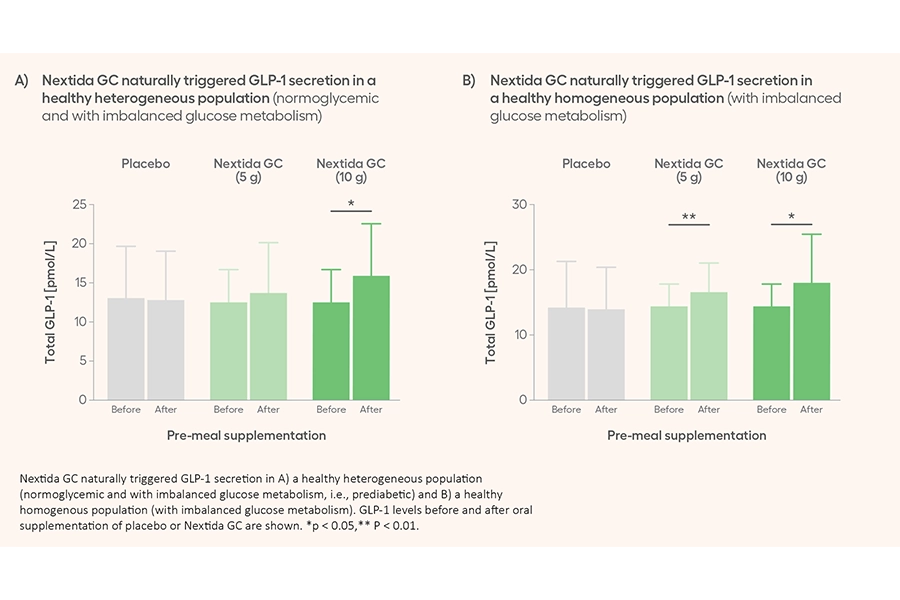 Nextida GC has naturally triggered GLP-1 production in healthy populations (Image credit: Rousselot).“We believe both sides of the opportunity are generating strong commercial interest and carry significant potential. By now, most of us likely know someone on GLP-1 medication therapy — so this segment is fertile for GLP-1 companion innovations,” says Moreno Torres-McLaverty.
“At the same time, increased awareness driven by the ‘GLP-1 revolution’ has created growing consumer interest in supporting the body’s natural GLP-1 production and overall metabolic well-being. For many healthy individuals, medication may not be appropriate or necessary, making natural supplementation an attractive alternative to help meet those wellness goals.”
We previously spoke with Rousellot, exploring the dual-route GLP-1 strategy in detail.
Where does collagen fit?
The GLP-1 companion space has become crowded fast, with increased focus on protein, biotics, and fiber as dominant ingredients to fill nutrient gaps against muscle loss and support gut health.
Moreno Torres-McLaverty points out the important role that collagen can play in addressing secondary effects of GLP-1 therapy, such as skin sagging, commonly referred to as “Ozempic face,” gastrointestinal symptoms, and muscle and bone mass loss.
“Collagen, being the most abundant protein in the body, plays a key role in maintaining and supporting the normal function of such. For example, for skin beauty, as it has been observed in various peer-reviewed clinical studies, Peptan increases dermis density for improved skin strength and elasticity alongside skin hydration, which can help reduce wrinkles and sagging skin.”
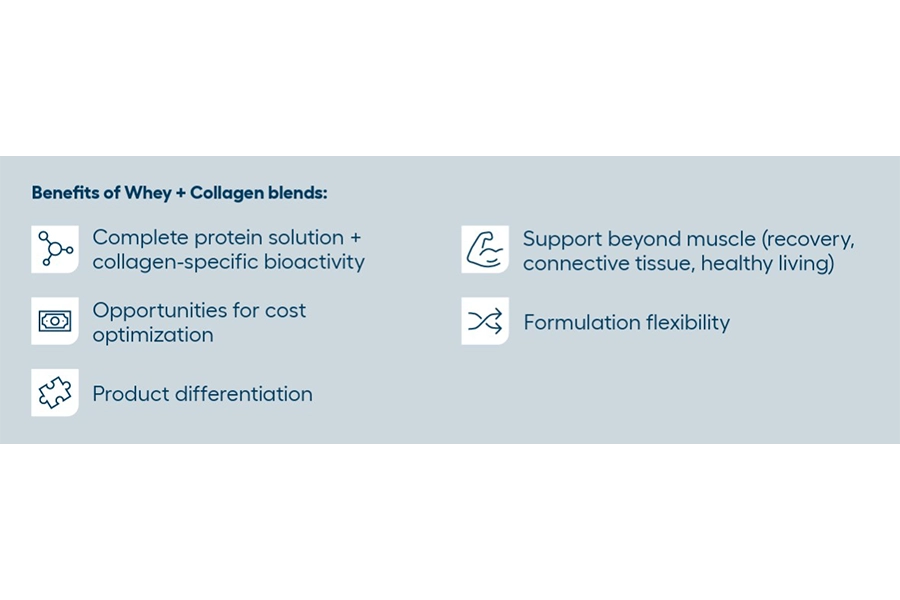 Torres-McLaverty says that pairing whey protein and collagen results in an upgraded protein system (Image credit: Rousselot).She points to a study showing Peptan could also improve bloating and digestive discomfort by supporting the intestinal barrier function. Additionally, preclinical research has revealed that Peptan increased bone density and supported bone mass.
“Lastly, being a pure protein, collagen peptides provide prevention of muscle loss, support for muscle recovery, and an extra nutrition boost to support lean muscle mass. As we can see, the myriad of benefits brought by collagen (and specifically Peptan) is what makes it stand out as such a relevant ingredient for GLP-1 companions,” shares Moreno Torres-McLaverty.
Upgrading the protein system
A key concern among GLP-1 patients is the risk of losing muscle. Up to 40–60% of GLP-1-supported weight loss can come from lean muscle mass rather than fat if not actively managed, explains Moreno Torres-McLaverty.
While collagen is not a complete protein, Rousselot believes it serves as a powerful complement rather than a replacement.
“Collagen misses the essential amino acid tryptophan, but it is rich in hydroxyproline (which, for instance, whey protein does not have), and it is this hydroxyproline that drives the bioactivity and the so well-recognized ‘world of benefits’ attributed to collagen peptides.
So pairing up whey protein and collagen, as an example, results in an upgraded protein system ideal to cater to GLP-1 users’ nutritional needs from many fronts.”
On formulation practicalities using premium collagen peptides such as Peptan, Moreno Torres-McLaverty points to various benefits, including an excellent sensory profile, superior solubility in hot or cold water, stability across a wide range of pH values, and heat resistance
“Due to its versatility, it can be applied to all sorts of formats — from high-protein and fiber-ready meals or snacks to nutritional shakes, just to name a few. This is key because GLP-1 users tend to prefer smaller formats packed with nutrients.”
“Starting at 5 g, Peptan has already been observed to provide skin beauty benefits — if formulators would like to tap into the mobility, gut, bone, and muscle support benefits starting at 8 or 10 g and even 20 g daily, it would be another viable option.”