



Harnessing postbiotics: Nutraceutical innovations for the gut microbiome


Key takeaways
- Postbiotics, though lesser-known than probiotics, are gaining traction as consumers increasingly understand the gut’s role in overall health and immunity.
- Postbiotics offer broader formulation potential than probiotics, as they remain effective without the need for live bacteria.
- As consumer interest in gut health grows, postbiotics can ride the wave of probiotic popularity, offering benefits across various health areas.

At the recent Natural Products Expo West 2026 trade show, gut microbiome support took center stage, with benefits in digestion, mood, immunity, skin health, and beyond. At the show, Nutrition Insight explored postbiotic developments and probiotic innovations with experts from Cargill, Kerry, and Morinaga Nutritional Foods.
Dr. Justin Green, senior scientist at Cargill, told us that although postbiotics are lesser known among consumers, they are “catching on,” which he highlighted as a key reason why formulators look for postbiotics, in addition to their application potential.
He pointed to a growing consumer understanding that the gut is at the center of the immune system and general well-being, which is supported by research. “It all starts in the gut, and that’s something more and more consumers are embracing as a path to overall health.”
“People often say that 70% of our immune system is in the gut. What they mean is that if you count all the cells in the body involved in immunity, many of them are in the gut. We have epithelial cells, and the lining of the gut contains immune cells.”
“Why would that be? Because when we evolved — before pasteurization — we were eating dirty food. We were more at risk from what we ate than from the air we breathed or the things we touched. Because of that, our immune system became highly tuned to the gut.”
Green explained that the gut’s immune system has to discern from all the foreign materials that enter the gut when we eat which materials are toxic or nutritious and what is a good or bad bacterium.
“That means there is a huge pool of different types of bacteria and yeast we can draw from to create new postbiotics.”
Katy Kinsella, business development director of ProActive Health at Kerry, added: “The science of what’s happening in the biotic space — from prebiotics and probiotics to postbiotics — continues to evolve.”
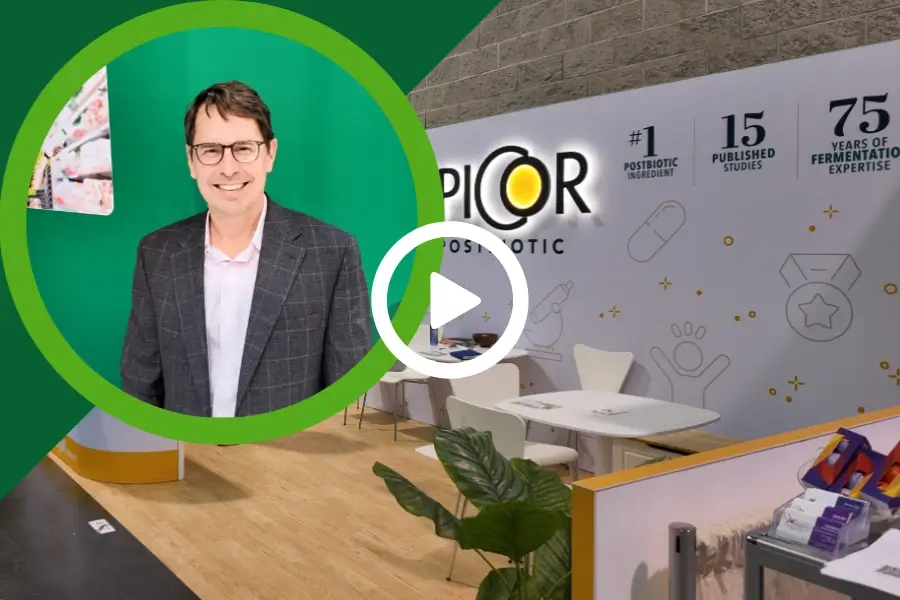 At Expo West 2026, Dr. Justin Green highlighted scientific research on Cargill’s EpiCor postbiotic for immune health.She detailed that researchers and companies are constantly learning what the trillions of bacteria in people’s bodies are doing to determine how to feed them and make them healthier, “better for you,” and more active.
“I love learning more about where we can take our business and where we can find different partnerships to continue to grow the space — and the biotic space in particular.”
How postbiotics were born
While postbiotics such as fermented foods have been around for a while, the term is quite new, said Green. He explained that the term was defined by the scientific community in 2021 to describe deactivated and inanimate microbes.
He said that previously, the industry and researchers believed that microbes needed to be alive for their health benefits. “This came from the realization that the microbiome is very important for our health, and the microbiome is alive. It was thought that probiotics are good for you because they get into the gut and colonize there.”
“That was usually true, so researchers would do experiments where you had the live probiotic and, as a negative control, the dead probiotic. Usually, that live probiotic would be the only one that gave a health benefit.”
However, Green noted that, every once in a while, a dead probiotic would also provide a health benefit, and sometimes even more than the live microbes.
“A second mode of action was identified where the microbe did not need to be alive and did not need to colonize the gut. All it needed to do was interact with the gut lining.”
Although the term is lesser known among consumers than probiotics, Green said that postbiotics offer more microbes to work with.
“One reason is safety,” he explained. “With probiotics, you cannot use anything where there might be concern about infection, because they’re alive. So you have much more room for postbiotics.”
 Compared to probiotics, postbiotics are more stable and can more easily be incorporated in various food products, such as self-stable drinks.“After all, we didn’t just evolve to interact with the microbes in our gut — we evolved to interact with everything in our environment.”
Formulating with biotics
A key benefit of postbiotics is their formulation potential, as these inanimate microbes are generally much easier to use in a wider range of product applications than probiotics. As live organisms, they have to stay alive during shelf life to provide health benefits.
However, Kerry’s Kinsella pointed to the company’s BC30 probiotic, a Bacillus coagulans strain, as a very stable option. This probiotic supports digestion and boosts protein absorption.
“The beauty of BC30 is that you can use it in a number of food and beverage applications where you can’t use other bacteria or probiotics, because their vegetative cells are constantly germinating and dying.”
“The whole point of having a probiotic is that it needs to be efficacious at the time of consumption,” she underscored. “That’s our big focus — efficacy at time of consumption — because otherwise you’re not getting the benefit.”
Meanwhile, Kinsella also highlighted Kerry’s postbiotic Plenibiotic, which has multiple health benefits, such as digestion and skin health support.
“There are some things you just can’t put a probiotic into because of a kill step or because it’s a shelf-stable beverage, for instance. That’s where Plenibiotic can come in, because it is inactivated — it’s not alive.”
She noted that the postbiotic can be used in “almost any application without the fear of killing it or losing efficacy.” This broadens the arena in which the company can employ its ingredients and add health benefits.
Consumer awareness
Kyoko Saito, sales manager of functional ingredients at Morinaga Nutritional Foods, highlighted that consumers are becoming more educated and skeptical about supplements’ effectiveness.
“They are not just looking for a general product,” she detailed. “They are looking for more clinically validated and mechanistically driven functionality, even more than before.”
 ADM’s Vaugh DuBow highlighted the company’s range of postbiotics and GLP-1 innovations at Expo West 2026.“At the same time, they are also looking for convenience. They are more interested in food and beverage, those easier-to-consume applications.”
Green at Cargill added that while postbiotics are not as well known among consumers as probiotics, they can benefit from consumers’ growing awareness of the impact of their gut microbiome on other health aspects.
“They can ride the coattails of probiotics — not just because the terms sound similar, which they do, but because they work through the gut to deliver health benefits.”
He highlighted a study Cargill conducted a few years ago among consumers taking probiotics. The company asked them if they would be interested in taking a postbiotic, even if they didn’t know what that was. “Ninety percent of those respondents said they would be interested.”
“Essentially, interest in postbiotics is already baked into the strong interest consumers have in probiotics. And interest in probiotics, frankly, is still continuing to rise. People keep thinking it has peaked, but it hasn’t. There is still a lot of room for consumers to buy into the fact that good gut health translates into benefits for many other systems in the body.”
While Cargill’s EpiCor postbiotic benefits the immune system, Green noted that other postbiotics can help brain or joint health.
Gut-brain axis
Morinaga Nutritional Foods is championing the gut-brain axis in 2026. At Expo West, the company highlighted its latest postbiotic strain, LAC-Living+, which it said is easier to incorporate into functional food and beverage formats than probiotics.
Saito said that clinical studies on this postbiotic (Lactobacillus helveticus MCC1848) show support for mood, an uplifting quality of life, and reduced fatigue.
“In this very stressful world and across industries, I think our postbiotics and the newest launch of the probiotic Bifidobacterium breve MCC1274 for cognitive support really fit current consumer demand.”
Also at the show, ADM showcased its postbiotics, such as Lactobacillus gasseri CP2305, which may support stress reduction, mood enhancement, and improved sleep quality via the gut-brain axis.