



PLT’s Ceratiq phytoceramides may calm sensitive skin and boost dermal density

Key takeaways
- Ahead of publication, PLT Health Solutions highlights a clinical trial suggesting that a daily 350 mg dose of Ceratiq significantly reduces TEWL and visible skin redness in individuals with sensitive skin.
- Research using ultrasound and Cutometer measurements shows that supplementation improves dermal density, firmness, and hydration over a 90-day period.
- The findings are backed by a research program spanning seven human clinical studies conducted across multiple independent laboratories over more than two decades.
 (All image credits: PLT Health Solutions).
PLT Health Solutions has shared new randomized clinical research on its Ceratiq ingredient indicating that it offers benefits beyond hydration and wrinkle appearance. Although the two studies have not been published yet, the company says they detail how the gluten-free, phytoceramide-rich wheat lipid extract supports the structure of sensitive skin while reducing its reactivity.
According to the company, Ceratiq supports skin from within by helping maintain barrier integrity and supporting the collagen-rich dermal matrix, which is the structural foundation associated with skin density, firmness, hydration, and a smoother appearance.
Available in oil and powder formats, Ceratiq can be formulated in dietary supplements, functional foods, and beauty-from-within products at a clinically supported daily dose of 350 mg.

“These studies are part of a research program unmatched in its breadth and quality in the phytoceramide category — with seven human clinical studies, hundreds of participants, research conducted at multiple independent laboratories, and validated methodologies that produce credible, reproducible results,” says Sid Hulse, VP of Product Development for PLT Health Solutions.
PLT Health Solutions shared the findings from these two clinical studies ahead of their publication in a peer-reviewed scientific journal.
Sensitive skin support
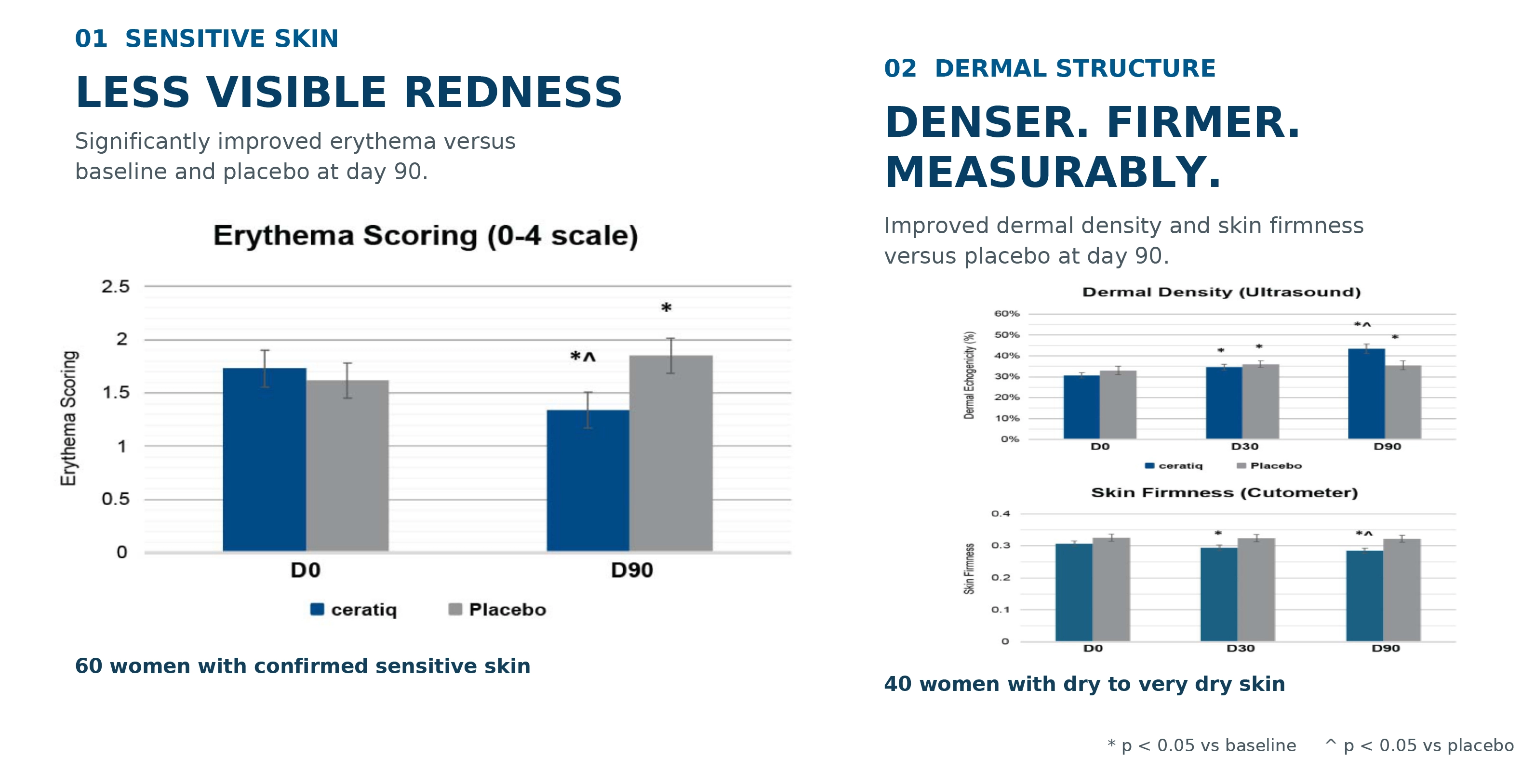
The first randomized clinical study involved 60 women with sensitive skin, which was confirmed by a lactic acid stinging test. They consumed a daily dose of 350 mg of Ceratiq or a placebo.
According to PLT Health Solutions, overall findings suggest that Ceratiq significantly reduced transepidermal water loss (TEWL) and reduced erythema (redness), indicating that it supports skin barrier function. TEWL is an objective measurement of the amount of water that escapes through the skin and is commonly used to evaluate barrier integrity.
Scientists measured the women’s erythema using a standardized redness-scoring scale. After 90 days, they report that Ceratiq produced a significant improvement in erythema compared with baseline and placebo levels, suggesting that the benefits extended beyond subjective perceptions of sensitive skin.
 PLT Health Solutions has published the findings ahead of their release in a peer-reviewed journal.PLT Health Solutions says that preclinical research provides additional support for reduced skin-reactivity signaling, helping explain the benefits observed in the clinical study.
Jennifer Murphy, M.S., R.D., head of Innovation and Clinical Science for PLT Health Solutions, sees the studies as propelling the science around Ceratiq into “important new territory.”
“The sensitive-skin study connects stronger barrier function with reductions in TEWL and visible redness.”
Supporting dermal density
In the second randomized, double-blind, placebo-controlled study, 40 healthy women with dry to very dry skin consumed 350 mg/day of Ceratiq or a placebo. PLT Health Solutions points to findings suggesting that this protocol improved dermal density, skin hydration, firmness, and wrinkle appearance.
The researchers measured dermal density using ultrasound, while evaluating firmness using a Cutometer. These instrumental measures offer objective data of changes in skin structure and mechanical properties, which PLT Health Solutions says are unique assessments in the beauty-from-within category of dietary supplements.
Improvements in dermal density were evident after 30 days and were significant compared with placebo at 90 days, reports the company. Skin firmness was also significantly improved versus placebo at day 90, showing that the structural changes translated into a measurable functional benefit.
Building on decades of research
PLT Health Solutions highlights that the new findings build on more than two decades of Ceratiq research. Researchers have evaluated Ceratiq in seven human clinical studies involving hundreds of participants.
The studies have been conducted at multiple independent research sites and employ validated methods, such as corneometry, ultrasound, Cutometer measurements, and established wrinkle-rating scales.
One paper showcased how the ingredient increased hydration beginning at four weeks and reduced wrinkle appearance beginning at eight weeks, with benefits maintained for eight weeks after supplementation ended.
“The number of studies matters, but study quality matters just as much,” Hulse says. “With Ceratiq, brands get the confidence that comes from a deep, consistent body of evidence, with repeatable results, a clinically substantiated dose, and science that supports a broader, more compelling beauty-from-within position.”
Earlier this year, PLT Health Solutions partnered with AI-powered human health researcher Alethios to accelerate and scale the clinical research behind finished formulations for different brands while reducing traditional bottlenecks.