



CPHI Milan 2026: Bioiberica eyes longevity and GLP-1 as healthy aging becomes targeted


Key takeaways
- Bioiberica’s Mónica Gómez Navarro tells us the lines between pharmaceutical and nutraceutical spaces are increasingly blurring.
- She names longevity and GLP-1 companions as the two macrotrends set to reshape the healthy aging category, moving beyond broad claims to targeted solutions.
- Bioiberica sees the strongest momentum in mobility, beauty, and digestive health, spotlighting undenatured type II collagen and a DAO enzyme for histamine intolerance.

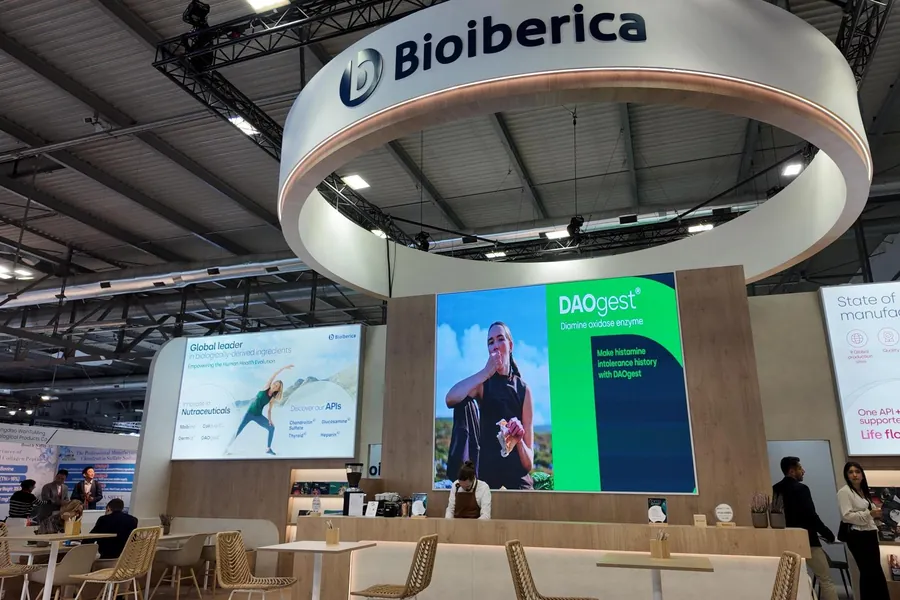
In Italy, at the ongoing CPHI Milan 2026 trade show, Nutrition Insight meets with Bioiberica, which is showcasing branded nutraceuticals and a diverse range of active pharmaceutical ingredients, alongside more than 40 ongoing heparin research projects.
On the showroom floor, Mónica Gómez Navarro, marketing manager for Branded Ingredients at Bioiberica, tells us about upcoming macrotrends in the nutraceutical industry and the global life sciences company’s business decisions that the market has not yet fully understood.
“A few years ago, we decided to spotlight our nutraceutical-branded ingredients offering for the first time at CPHI, reflecting a key turning point in the health care industry’s ongoing evolution, where the lines between the pharmaceutical and nutraceutical spaces are becoming increasingly blurred.”

“Today, we’re continuing to build on this, and we’re always looking at how we can adapt our offering to respond to shifting market trends,” she says. “Most recently, we’ve evolved from ingredient-led positioning to health-journey platforms, connecting our science-backed branded ingredients for mobility, beauty, and digestive health to healthy longevity, supporting people’s overall quality of life and everyday wellness.”
Reflecting on this trajectory, Gómez Navarro says it shows that people are thinking about healthy aging differently today — less about anti-aging and more about supporting health and independence longer.
“For brands, this means looking beyond individual benefits and considering how targeted ingredients can support people’s healthspan in the long term. Against this backdrop, our focus is on helping our partners identify where science-backed, specific solutions can add value across different stages of life,” Gómez Navarro comments.
 Bioiberica has evolved from ingredient-led positioning to health-journey platforms.Furthermore, she sees a need for greater industry collaboration to share insights among ingredient suppliers, brands, researchers, and other experts to build consumer trust. “This requires clear and consistent communication and education around ingredient characteristics, science, and demonstrated effects.”
From healthy aging to targeted goals
According to Gómez Navarro, the healthy aging category will look different in over a year, with longevity and GLP-1 companions becoming the two major macrotrends.
“Also, mobility, gut health, and women’s health are increasingly converging around prevention and quality of life. The opportunity will be to move beyond broad ‘healthy aging’ claims toward targeted solutions with clearly defined benefits and strong clinical evidence, supported by consumer education.”
“Research shows that around two in five consumers across the UK and US are currently considering what ‘healthspan extension’ could mean for them,” notes Gómez Navarro. “If we want to bring people on board with this new approach to healthy aging, it’s important that we, as an industry, do more to provide clearer communication and ensure everyone understands it.”
Fastest-growing ingredients
Bioiberica is experiencing the strongest momentum across mobility, beauty, and digestive health. Gómez Navarro says that this shows growing interest in longevity and more targeted approaches to everyday well-being.
 Gómez Navarro believes the healthy aging category will look different in over a year, with longevity and GLP-1 companions becoming the two major macro-trends.“In the mobility space, we’re seeing high demand for Collavant n2, a native (undenatured) type II collagen that works at a low dose (40 mg/day) through a mechanism of action called Oral Tolerance, an immune-mediated process that recognizes type II collagen as a known substance and deactivates the body’s immune response,” she details. “Thanks to this specific mechanism of action, it takes just a small amount of native type II collagen to support joint health.”
She points to histamine intolerance as an “area to watch” in the digestive health space. “While it remains poorly defined and largely under-recognized within the nutrition industry, a recent survey found that around 15% of consumers worldwide (sample size: 16,000) report experiencing histamine sensitivity or intolerance some or most of the time, bringing this once-overlooked condition into focus.”
Bioiberica’s premium diamine oxidase (DAO) enzyme solution, DAOgest, can support histamine metabolism, for instance, says Gómez Navarro.
What customers need to understand about collagen
Reflecting on what customers most often get wrong about the collagen category, Gómez Navarro points out that the nutrient is commonly treated as a single, interchangeable ingredient.
“Some products rely on generic collagen claims without considering whether the collagen composition, source, dosage, or supporting evidence are appropriate for the intended benefit,” she explains. “This matters because consumers are increasingly looking for specific ingredients with clearly defined science-backed benefits.”
“As collagen moves into new health spaces, including healthy aging, scientific rigor will be essential to ensuring consumers can trust the benefits behind the products they choose. More broadly, joint, gut, and skin health are often treated as separate needs, while consumers are increasingly looking for solutions that support overall well-being and healthy aging.”