



ACLM pitches lifestyle medicine to address chronic disease and planetary health


Key takeaways
- The ACLM proposes a “triple-benefit model” that uses six core pillars to target chronic disease while improving community and planetary health.
- ACLM suggests plant-predominant diets and physical activity may lower health care costs, boost life expectancy, and reduce food-related emissions and land use.
- It notes that expanding lifestyle medicine could address the root causes of diseases, cutting reliance on resource-intensive medical care and reducing the environmental footprint of health care.

The American College of Lifestyle Medicine (ACLM) has published a position paper suggesting that “lifestyle medicine” offers an evidence-based practical framework to jointly address public health threats of chronic diseases and growing global environmental challenges such as biodiversity loss and climate change.
ACLM’s lifestyle medicine concept is a multi-pronged approach tackling the root causes of chronic illnesses through optimizing food-based nutrition interventions, regular physical activity, restorative sleep, and stress management.
More broadly, the paper proposes a “triple-benefit model” designed by ACLM researchers to optimize these personal wellness outcomes alongside those related to societal and planetary health.
Nutrition Insight speaks to ACLM research information specialist Kathy Pollard, co-author of the paper, to learn more about this layered approach. She argues that many of today’s most pressing health challenges arise from shared systemic drivers that require integrated solutions.

“Considering what is good for the planet usually yields healthier products,” Pollard underscores.
For instance, she highlights how using less packaging and reducing food manufacturing waste can lower pollution and greenhouse gas emissions—ultimately leading to lower rates of respiratory illness and heart disease.
Six interconnected pillars
In its paper published in the American Journal of Lifestyle Medicine, ACLM proposes lifestyle medicine’s six pillars — optimal nutrition, physical activity, restorative sleep, stress management, connectedness with others, and avoidance of risky substances. The organization says these can benefit both individual and environmental health.
For instance, referring to a modeling study, the paper suggests that shifting to healthy, sustainable, and plant-predominant diets could reduce food-related greenhouse gas emissions by around 49%, land use by 76%, and freshwater withdrawals by up to 32%.
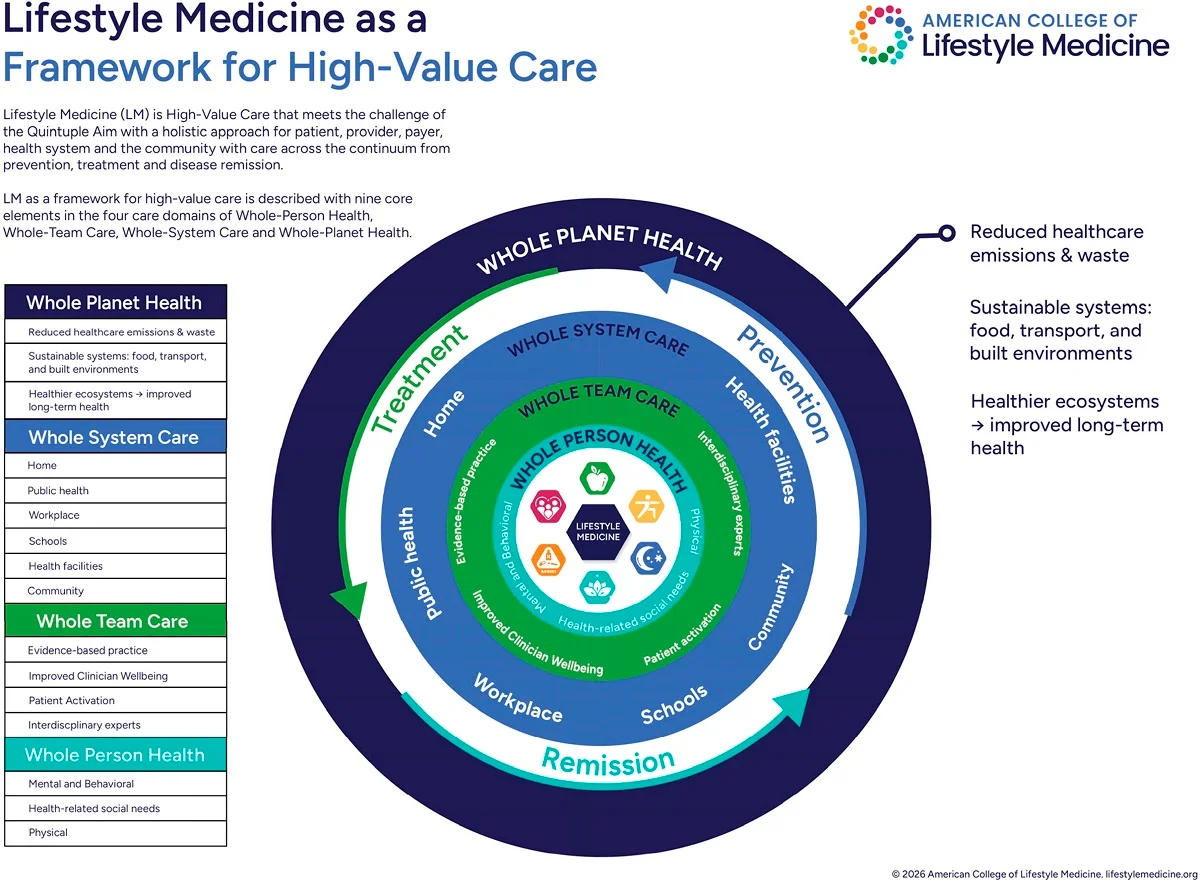 Framework of lifestyle medicine as an approach to high-value care across interdisciplinary fields (Image credit: ACLM).Moreover, pointing to another study, the paper suggests that dietary changes started at age 20 could increase life expectancy by 10 to 13 years.
The position paper outlines that localized food production, plant-predominant dietary patterns, physical activity such as walking and cycling, and community-based health initiatives may simultaneously improve health outcomes while reducing greenhouse gas emissions, pollution, and resource consumption.
Studies cited in the paper show that adopting the EAT-Lancet planetary health diet reduces risks of type 2 diabetes, stroke, and cardiovascular mortality, while eating more fruits and vegetables may protect against air pollution-related respiratory and cardiovascular damage through antioxidant mechanisms.
Meanwhile, other cited evidence suggests that physical activity reduces ischemic heart disease and diabetes through increased exercise and lower pollution exposure.
“Local food production, in particular, would decrease transportation costs and emissions. Meanwhile, healthier food offerings based on minimally processed, whole plant foods would benefit both personal and planetary health,” Pollard highlights.
She adds that products manufactured in zero-carbon facilities using renewable energy sources — such as on-site wind turbines or solar panels — could set an industry precedent.
“Additionally, transitioning from processed meat production to plant-based food alternatives would likely preserve fresh water and build cleaner communities. Establishing food production guidelines that explicitly support planetary health presents a powerful new target for manufacturers to strive for.”
Health care burdens
The paper also states that health care itself contributes to environmental degradation, accounting for an estimated 8.5% of US greenhouse gas emissions while also generating large amounts of medical waste, including chemical and plastic pollution.
ACLM’s paper details that clinical operations — such as diagnostic tests, procedures, hospital stays, and pharmaceuticals — drive 70% to 80% of all health care sector emissions. It notes that the US health care sector is the 13th-largest greenhouse gas emitter globally.
With all this in mind, the paper aligns with health care’s expanded “Sextuple Aim,” which adds environmental sustainability to the priorities of patient experience, population health, cost reduction, clinician well-being, and health equity.
 The ACLM authors of the position paper argue that the broader adoption of lifestyle medicine could help reduce demand for resource-intensive care by treating, reversing, and preventing chronic disease.The authors argue that the broader adoption of lifestyle medicine could help reduce demand for resource-intensive care by treating, reversing, and preventing chronic disease. They cite evidence from programs like the Ornish, Esselstyn, and Pritikin models, showing how lifestyle interventions can reverse chronic diseases and reduce medication reliance, often surpassing standard drug therapy.
“ACLM knows firsthand that there is a growing interest in nutrition education among clinicians, which is an educational need that ACLM fills. We need to change the focus in health care from managing disease to treating the root cause, which will lower health care costs and waste,” says Pollard.
Food as medicine movement
“Food as medicine” is an evolving healthcare movement that uses targeted nutrition and dietary interventions — spanning initiatives like produce prescriptions, culinary medicine, and medically tailored meals — to prevent and manage chronic conditions.
Assessing real-world feasibility, NYC Health + Hospitals served over two million plant-based meals to patients between 2022 and 2025. In 2023, it achieved a 36% drop in meal-related carbon emissions alongside an estimated US$0.59 in savings per meal.
Earlier this year, the Food Is Medicine Coalition and Harvard Law School released a “first-of-its-kind” national framework designed to inform hospital professionals how to introduce medically tailored meals into the US health care system.
The Rockefeller Foundation also forecasted that Food is Medicine programs could significantly boost the US economy, injecting over US$45 billion in economic activity and generating jobs. However, experts say that its success hinges on whether states prioritize local sourcing and investing in food system infrastructure to grow the local economy.
“Health care must evolve beyond simply managing disease,” stresses Pollard. “By embracing lifestyle medicine, we have an opportunity to improve health outcomes and restore health while helping safeguard the environmental systems on which future generations depend.”
ACLM states that, since 2004, it has trained more than 100,000 health professionals and made more than 1.75 million hours of accredited continuing education available through courses and conferences for physicians and health professionals.