



Oleosomes offer clean label plant-based functionality with nutrient delivery potential


Key takeaways
- Botaneco is developing water-based oleosomes as clean label fat and emulsification systems for plant-based foods.
- The company says nutrient delivery and lipid digestion remain research opportunities, not proven health benefits for its ingredients.
- Oleosomes could reduce reliance on separate emulsifiers and texturizers — a move that may matter for how these products are viewed in the UPF debate.
As clean labels remain a priority for consumers, the nutrition industry is focusing on how processing and ingredient structures do not just impact taste and texture but also nutrient delivery and digestion. Manufacturers are also exploring how to prevent plant-based products from being classified as ultra-processed foods (UPFs).
The plant-based meat and dairy alternative space is especially seeing increasing interest from R&D and nutrition researchers in simplifying formulations and modulating fat release to improve consumer eating experiences and nutritional profile. Innovators are trying to reduce reliance on added emulsifiers, exploring oleosomes as a natural delivery system for lipids and fat-soluble compounds.
Early oleosome research, based on laboratory tests, simulated digestive models, and animal studies, is finding that its structure could impact lipid digestion and bioaccessibility of fat-soluble compounds. However, ingredient-specific human evidence is lacking.
Against this backdrop, Botaneco is developing a water-based oleosome platform, which offers a potential but as-yet-unproven impact on lipid digestion and nutrient delivery. Nutrition Insight explores how the ingredients manufacturer’s processing platform extracts value from oilseeds, such as canola, hemp, sunflower, and safflower, for plant-based meats and dairy alternative applications.
“Botaneco’s food platform is at the application development and partner validation stage,” says Jason Hargreaves, director of R&D. “We are using our laboratory and pilot-scale facilities to identify where oleosomes offer a clear functional or commercial benefit, validate their performance, and refine product specifications.”
“This has resulted in a suite of oleosome products for food, under our Purezome brand, that we are very excited to share with prospective partners.”
He adds that the company’s facility in Calgary, Canada, enables manufacturing at a multiple-ton scale for commercial personal care production and initial quantities for food development. “Moving to broader food commercialization will require application-specific validation, regulatory and food-safety work, and additional manufacturing capacity as demand grows.”
 Jason Hargreaves, director of R&D (Image credits: Botaneco).Botaneco is prioritizing partnerships over a broad-market launch to develop targeted applications, carry out customer sampling and formulation trials, and then develop initial commercial platforms.
“Recent discussions with potential partners are centered on practical topics like performance, product format, scale-up, and market access. At this stage, we do not consider the food platform to be broadly commercial,” Hargreaves shares.
Oleosomes and UPF status
Consumers are becoming more wary about processed foods as the debate about the healthfulness of UPFs continues. The challenge has also extended to plant-based and minimally processed claims.
Hargreaves urges companies to choose labels carefully and accurately since they mean different things for consumers, regulators, and food-classification systems. They should not be seen as “substitutes” for nutritional quality. “It is important to use terms such as ‘clean label,’ ‘naturally derived,’ and ‘less processed’ with precision,” he stresses.
“We can, however, describe our process objectively. Conventional oilseed processing typically extracts and refines the oil, which may then be combined with emulsifiers and other ingredients to provide the desired functionality. In contrast, Botaneco uses a water-based separation process designed to preserve intact oil bodies while recovering protein and other useful co-streams from the seed.”
Hargreaves explains that this process alone does not mean the finished product will be classified as ultra-processed. This is because UPF classification examines the complete formulation, ingredients used, purpose, and extent of processing, and the classification framework used.
“An oleosome ingredient may help simplify a formulation by providing fat delivery and emulsification within one system. However, the classification of the finished food must be assessed on a case-by-case basis.”
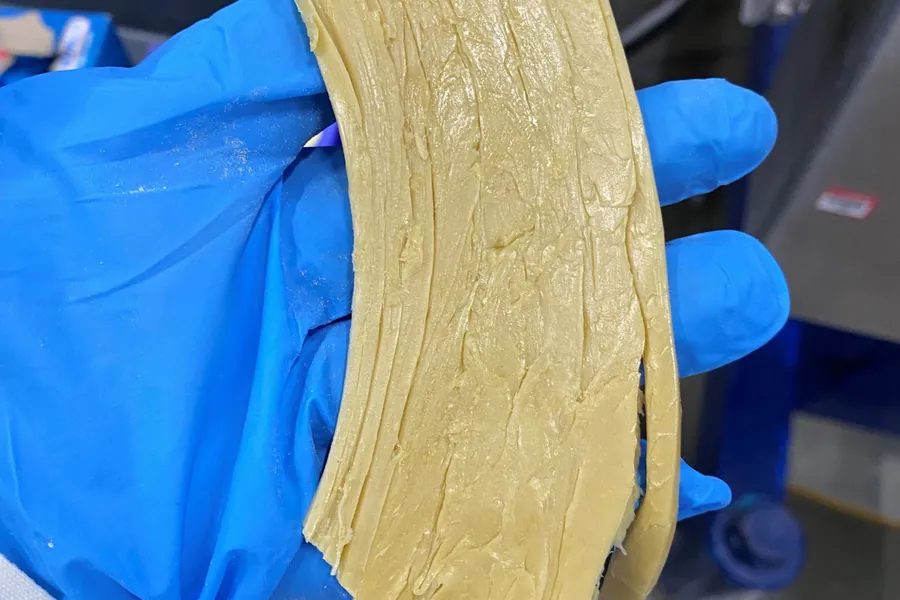 Hargreaves says oleosome ingredients may help simplify formulations by providing fat delivery and emulsification within one system (Image credit: Botaneco).“For that reason, we avoid making categorical non-UPF claims without an application-specific evaluation,” details Hargreaves. “However, when compared with refined oil alone, it is clear that oleosomes are less processed since they have not encountered chemicals, heat, or pressure and comprise the oil that the seed itself has made.”
Potential to explore nutrient delivery
Oleosomes can deliver fat as an intact, naturally emulsified oil body rather than extracted oil. Hargreaves explains that the oleosome’s intactness raises important scientific questions about how the oil is delivered and digested compared to conventionally extracted oil.
For instance, a review in Pharmaceutics revealed that oleosomes’ structure can support “solvent-free extraction, self-emulsification, and near-complete encapsulation of highly lipophilic compounds, including curcumin and cannabidiol, with reported efficiencies exceeding 95%. These plant-derived droplets enhance oral bioavailability through lymphatic uptake.”
However, Hargreaves cautions: “It is important to distinguish this research potential from claims Botaneco can currently support. Our food-development work currently focuses on functionality, including emulsification, texture, mouthfeel, fat delivery, and formulation performance. At this time, we are not making clinical claims that Botaneco’s oleosome ingredients improve lipid digestion, nutrient bioavailability, satiety, or other health outcomes.”
“Any such claim would require ingredient-specific evidence. This could include controlled in vitro digestion studies, compositional analysis, and, depending on the proposed claim, human clinical studies,” he notes. “Evidence concerning oleosomes generally would also require careful assessment before being applied to a particular Botaneco ingredient, crop, format, or finished food.”
 Hargreaves explains that the oleosome’s intactness raises important scientific questions about how the oil is delivered and digested compared to conventionally extracted oil.Additionally, Hargreaves points to academic literature that supports that the native oil-body structure might be a useful platform for future nutrition research, such as delivering oil-soluble compounds.
Cost and food applications
Higher prices can often be a barrier for novel plant-based fats. According to Hargreaves, cost parity requires careful evaluation since oleosome ingredients will be compared to commodity oil systems.
“The price per kilogram alone does not capture the full value,” he states. “The key measure is cost in use: whether a single ingredient can reduce the need for separate oils, emulsifiers, or texturizers while improving product performance.”
“The protein co-stream also supports the economics of processing the whole seed. Final pricing will depend on crop, format, concentration, volume, and required functionality and has not yet been set for broad commercial sale.”
Additionally, oleosomes have a broad functional performance, such as fat delivery, emulsification, texture, and sensory properties in one, says Hargreaves. This sets them apart from conventional formulations that often combine extracted oil with separate emulsifiers and texturizers.
Co-stream value
Botaneco uses oilseed co-streams to separate oleosomes and proteins from oilseeds, resulting in high-value ingredients.
“Our goal is to avoid processing oilseeds for a single component and treating the rest as a lower-value by-product. The water-based process is designed to recover intact oil bodies, seed protein, and other useful streams, so each fraction can be directed to the application where it adds the most value,” explains Hargreaves.
“This whole-seed approach is expected to support the economics of the oil-body ingredient, especially compared to commodity vegetable oils. However, the specific economics will depend on crop costs, processing yields, product specifications, co-stream markets, and manufacturing scale.”
The company is reliant on crop availability, weather, quality variation, commodity pricing, and trade conditions such as other agricultural ingredient platforms, he adds. Although it can use several oilseed feedstocks for flexibility, the crops cannot be interchanged without impacting functionality, regulatory status, and customer requirements.
“At commercial scale, sourcing strategy, regional processing, and long-term relationships with growers and partners will be important for managing supply and trade risk,” concludes Hargreaves.