



Beneo targets functional confectionery with sugar-free isomalt and Palatinose candy concepts


Key takeaways
- Beneo unveils a Sweets Box with sugar-free and functional candy concepts featuring isomalt, prebiotic fibre, short-chain FOS, and the functional carbohydrate Palatinose.
- The concepts target functional confectionery demand with hard candies, gummies, and chewing gum for endurance and energy.
- Beneo positions Palatinose as a low-glycemic carbohydrate for products targeting GLP-1 medication users.
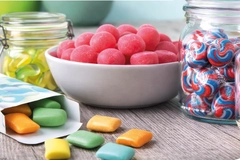 Image credit: Beneo
Beneo has unveiled a range of sugar-free confectionery concepts in a “Sweets Box” to showcase how formulators can reimagine traditional sweet formats to meet new consumer demands. The concepts include hard-boiled candies and chewing gum that feature the sugar replacer isomalt, alongside gummies with Beneo’s functional carbohydrate Palatinose.
The prototypes were developed through close collaboration between the company’s market intelligence and consumer insights team and experts at the Beneo-Technology Center and aim to “drive category innovation” by providing practical solutions for manufacturers.
The Sweets Box includes three hard candies inspired by matcha, energy drinks, and coffee to showcase how these sugar-free options can be adapted to suit different consumer needs, flavors, and usage occasions.
Nutrition Insight explores Beneo’s sugar-free confectionery concepts with Klaudia Volmer, product manager for functional carbohydrates at the company.
Volmer notes that the growing consumer interest in functional confectionery is a combination of demand for functional benefits and sugar-reduced options.
Referring to data from Innova Market Insights, she says that more than half of consumers are trying to reduce their sugar intake through reduced-sugar confectionery and snacks. Moreover, she notes that one in two consumers seek products to boost energy.
Volmer says the company named its Sweets Box “Layers of Delight” because it combines three factors. “The first one is about the sensation, texture, and excitement. The second layer is functionality, and here we are talking about sugar-free, but also energy and fiber-enriched. The third one is the indulgence, because nothing goes without indulgence in confectionery.”
Isomalt benefits
All the sugar-free candy concepts use isomalt, which Beneo highlights as the “leading sugar replacer” in hard-boiled candies. The sweetener is derived from sugar beet and has a mild, sugar-like taste that can be used in a wide range of flavor profiles. The company notes that the ingredient enables the creation of tooth-friendly products with reduced calories.
 Klaudia Volmer, product manager for functional carbohydrates at Beneo.Volmer highlights the sweetener’s high stability. “An isomalt candy can be unwrapped, lying in your car at temperatures of 35 ℃, and it will keep its shape. You can also use it for products that are not individually wrapped, as they don’t become sticky.”
“The first isomalt sugar-free hard-boiled candies were implemented in the market 35 years ago. In the meantime, this has become the gold standard.”
She says that isomalt is used in confectionery all over the world. “The main advantage is the shelf life stability, especially in high-humidity regions. Apart from this technological advantage, it enables beautiful hard candies.”
For example, Volmer highlights the Sweets Box’s Yuzu & Matcha Liquid Filled Candy concept, a hard-boiled candy with a matcha liquid center. Volmer notes that isomalt’s viscosity and stability help prevent leakage in these candies at high temperatures, which is a common issue in sugar-based candies.
She adds that the ingredient enables “crystal-clear colors” in the box’s Caramel Coffee Candy and Energy Drink Candy concepts, which both have a swirl of different colors. “This is a unique benefit of isomalt because of the crystallization behavior when it comes to sugar-free hard-boiled candies.”
Beneo also uses isomalt in the dual-layer coating of the chewing gum concept, aiming to make a familiar product work better. “Here, we combine xylitol with isomalt — xylitol because of the cooling and mouth-watering effect, which is very well known in chewing gum, and isomalt because it gives you very good stability.”
Moreover, she says that isomalt is low-hygroscopic, meaning that it does not take up water. In comparison, allulose, as a standalone sweetener, would not be suitable for hard boiled candies if a stable end product is required. Volmer notes that this is where isomalt shows its uniqueness.
Fresh flavors
Beneo highlights that isomalt is suitable for a range of flavor profiles, as it does not have a cooling effect that other sugar replacers do. Although consumers desire a cooling effect in some products, such as chewing gums, Volmer notes that they expect an authentic flavor without off-notes in products like chocolate or hard-boiled candies.
Moreover, because isomalt is not overly sweet, it helps to balance delicate flavors, she adds.
 Over half of consumers aim to reduce their sugar intake and one in two consumers seek products to boost energy, says Volmer.The hard candy concepts were inspired by drink flavors, because “the beverage industry is leading all the flavor innovations,” says Volmer.
Moreover, the company aimed to highlight different flavors, ranging from conventional and familiar flavors like caramel coffee to more niche options like energy drinks, designed for Gen Z.
She adds that customers can be more hesitant about more sophisticated flavors, such as matcha, which can be more polarizing among consumers. However, the combination with yuzu resulted in a “nice balance.”
Additionally, Volmer highlights that special or limited editions are underrated, especially in hard-boiled candies. For example, she notes that summer and fresh flavors are key for confectionery like hard candies, as these experience a drop in consumption over the summer.
Energy and fibermaxxing
The Sweets Box also includes a Crunchy Energy Gummy concept that is designed for endurance by delivering energy over time, rather than a quick sugar spike. Meanwhile, the Energy Drink Candy contains small amounts of caffeine, which can be partly absorbed in the mouth and may therefore act faster than when consumed through a drink, details Volmer.
In the soft gummies, Beneo also added Palatinose. Volmer explains that this functional carbohydrate offers a more stable blood sugar response, eliminating crashes that can lead to tiredness.
“This fibermaxxing trend was an inspiration for the Melting Tea Gummies,” she adds. “Including prebiotic fiber, you can eat these or drop them into hot water to dissolve into tea. They contribute to your fiber intake and are not overly sweet.”
“Smart sweetness” is increasingly important in confectionery products, Volmer notes. She highlights that these are increasingly used in sports. “For example, an endurance athlete may eat super sweet gummy bears. They can get tired of this over-sweetness, especially when you’re on a run.”
Volmer says the innovation in the tea gummy concepts opened the door for customer visits. “In every customer meeting, this was the most surprising concept — having a gummy that you can eat or dissolve as tea.”
Catering to a GLP-1 consumer
Volmer also spotlights the potential of Beneo’s Palatinose in developing products for GLP-1 users. People using these medications are known to eat less and therefore benefit from more sustained energy throughout the day.
 Volmer says the Sweets Box combines sensation, functionality, and indulgence for sugar-free confectionery innovation.Research indicates that Palatinose, a low-glycemic carbohydrate, can naturally stimulate GLP-1 secretion. “The data for Palatinose is consistent. In almost every study that we have, we have been measuring GLP-1,” adds Volmer.
She highlights that Beneo has been assessing the impact of Palatinose on GLP-1 or GIP (gastric inhibitory polypeptide) for a long time.
“When you have a GIP measurement, it shows that everything is digested at the beginning of the intestine, while GLP-1 shows that it’s digested at the end of the small intestine. Measuring that is how we show the slow and sustained release of Palatinose throughout the small intestine.”
Since the conversations around GLP-1 are becoming more mainstream, especially in the US, where it is becoming a “buzzword,” Volmer highlights a distinction in claims and communicating around GLP-1 in the US and Europe.
“In the US, we have a GLP-1 structure/function claim, but in Europe, our regulatory experts do not expect that there will be GLP-1 claims. GLP-1 is a mechanism, and in Europe, the claims are about the end benefit, which would be reducing weight.”
“There is a question whether reducing weight is a health benefit or a risk-reducing benefit — that would be a different kind of claim,” she adds. “Some people are putting it on their packaging, but for the larger companies in Europe, that could raise regulatory considerations.”
Although the US offers more flexibility than the EU to create product claims, Volmer underscores that Beneo’s claims are backed by science.
“Before we make a structure or function claim about our benefits, we always have a lawyer evaluate whether our science is strong enough in a worst-case scenario,” she details. “If we have seen a benefit once in a science study, it has to be proven several times in studies.”