



Flexible formats: SynbioTech says clinical science and postbiotics reshape market


Key takeaways
- Probiotic brands are shifting from potency claims to increasingly demanding market-specific clinical evidence, says SynbioTech.
- The company observes a rise in postbiotics, which offer format flexibility in food and beverages, but can be difficult to quantify in food matrices.
- SynbioTech focuses on healthy aging and immunity with TWK10 and Synmue, and is working with brands to co-develop clinical trials and synbiotics.

SynbioTech says that biotic brands are demanding stronger clinical evidence tailored to specific markets and populations, as well as greater formulation flexibility through postbiotics.
The Taiwan-based probiotics supplier sees rapid change in microbiome science in Asia-Pacific (APAC), where strong consumer awareness and easier access to scientific information are pushing product developers toward clinically validated benefits.
Nutrition Insight meets with Lisa Chen, marketing director at SynbioTech, to discuss the key changes she spots in the global biotics space.
She says that consumers already know that probiotics can support the gut or immune system, especially in Asia.
At the same time, she has seen AI and the internet change the biotics space in the APAC region, as consumers can obtain information very quickly. Chen says that, previously, in Taiwan, animal studies were sufficient to promote a product.

“But now, if a branding company wants to develop a product, it will ask you, ‘Do you have a clinical trial?’ The company doesn’t just trust the CFU or the high potency of the probiotics. It trusts that you have real science in their products.”
“Brands want to be able to tell their consumer, ‘If you buy my product, you can get a real benefit from it.’ I think that changed the whole microbiome science.”
Another key development Chen spots is the rise of postbiotics. Instead of live probiotics, these are heat-killed bacteria, which have broader applications in food and beverages, she details.
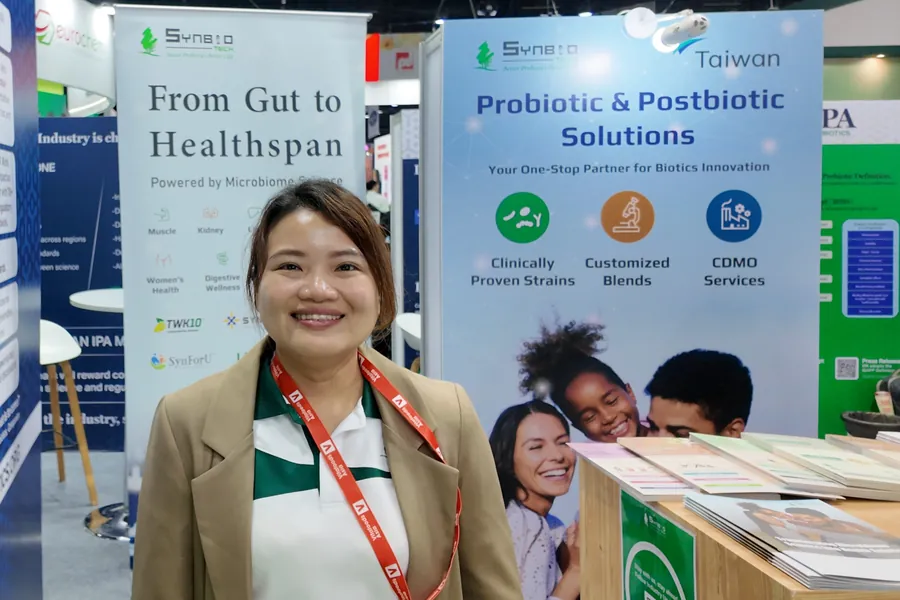 Lisa Chen, marketing director at SynbioTech.“That is completely different from the probiotic. Initially, they may be used in pharmaceuticals, then in dietary supplements, and now they can be added to food.”
“People want to be healthy, but not just through supplements — they are also looking for functional foods,” she adds.
Postbiotic innovations
Ingredient suppliers at Natural Products Expo West 2026 told Nutrition Insight that postbiotics are “catching on” among consumers as they gain an understanding of the gut’s role in overall health and immunity. This growing consumer awareness, along with postbiotics’ formulation flexibility, is driving interest among companies to work with them.
SynbioTech’s clients also increasingly ask for postbiotics, says Chen. “They want to create a gummy, functional food, or want to add it to a beverage.”
“Postbiotics offer more flexibility to apply in different formats, such as functional foods and beverages,” she adds. “But probiotics have a very specific benefit because they are alive. They may have an indirect effect, as they need to live in the gut to have an impact. Postbiotics can have a more direct effect.”
Although many companies now offer postbiotics, Chen cautions that testing the quantities in a product is difficult, especially in food. Food products use heat in processing, which can sometimes destroy the postbiotics, meaning that the content cannot be verified.
“If a company says that a gummy holds 10 billion cells, how can you prove it?”
Moreover, she notes there is no standard method to test postbiotic quantities in food products, so companies can use different ones.
Healthy aging range
Chen highlights two key areas that SynbioTech focuses on — women’s health and healthy aging.
 In a trial, people taking a TWK10 postbiotic experienced longer exercise endurance time than a control group consuming a placebo.“For us, women’s health does not only cover vaginal health, but the whole life of a woman, from a young girl, through middle age, to women older than 65.”
“We have two key products. One is for muscle health, TWK10. We know that muscle strongly affects someone’s health. This product connects the microbiome with muscles through the gut-muscle axis,” she adds.
Research on SynbioTech’s Lactiplantibacillus plantarum TWK10 links it to improved muscle function and mobility. The company says it is supported by 27 scientific publications, nine human clinical studies, and 18 global patents.
For example, a 28-day placebo-controlled human trial with 32 participants combined pea protein with TWK10 and resistance training. The study, published in Current Research in Food Science in 2024, found that TWK10 increased peak blood concentrations of total branched-chain amino acids by 6.9%, total essential amino acids by 3.8%, and total amino acids by 3.1% from baseline.
The control group, which did not consume the probiotic, showed decreases in these measures.
Research on a postbiotic version of TWK10 indicated that participants taking the ingredient for six weeks experienced significantly longer exercise endurance time than the control group consuming a placebo. The postbiotic also resulted in an increase in muscle weight.
Chen says that another core product of SynbioTech covers immune aging, which it launched in June 2026. “Synmue activates natural killer cells, which are very important for longevity and healthy aging.”
The company notes that after age 30, the body’s immune responsiveness changes gradually, and natural killer cells — “front-line defenders of the innate immune system” — may become less responsive over time. Synmue features L. plantarum LP28 to support natural killer cell activity.
“If you have insufficient natural killer cells, your immune system will have a problem,” says Chen.
She adds that SynbioTech also works with its customers to determine how to combine probiotics and postbiotics from its strains into one product. “For example, in healthy aging, immune aging and muscle health are both important, so we can combine these for this positioning.”
Cross-country collaboration
SynbioTech’s main market is in Europe, followed by North America. The company is also focusing more on the APAC region as it observes significant growth.
 Synmue activates natural killer cells, which Chen says are very important to support the immune system in aging people.Chen explains that when the team works with a US company, it might ask how its research translates into that country, as all SynbioTech’s clinical trials are done in Taiwan or elsewhere in Asia, where microbiomes may be different from those in North America due to variations in diet and lifestyles.
“When they work with us, many companies, especially large brands, will ask if we would like to do the clinical trial with them,” she adds. “They want to tell their consumers that there is not only a clinical trial with an ingredient but also with the finished product.”
“For example, we can work with a clinical research organization in Thailand or South Korea to determine a product’s suitability for those populations.”
Because SynbioTech is a medium-sized company, Chen says the team can be more flexible in the services it provides its clients and collaborate with them.
“Formulation design is very important,” she says. “Brands may have a lot of different products, making it difficult to understand all of them. We can provide technical support, help to design products, explain marketing trends, and highlight how to promote them.”
She says that brands need suppliers who can help fix their problems. “You may have a lot of clinical trials on your products, but if you cannot support brands or translate science into marketing language, clinical trials are useless.”