



Vegan diets found to halve carbon footprints and cut disease risk


Key takeaways
- Studies show vegan diets reduce carbon footprints by up to 46–51%, while also lowering land and water use.
- Shifting from meat-heavy to plant-based diets cuts noncommunicable disease risk and improves population health outcomes.
- School meal redesigns that replace meat and fish with legumes can reduce environmental impacts by around 50%.

Emerging research in plant-based food and environmental health encourages people to consume less meat and fish. Researchers also highlight this diet’s benefits for lowering communicable disease risks.
Nutrition Insight examines findings evidencing that vegan diets could halve carbon footprints in comparison to other diets and at school canteens, while significantly lowering water and land use.
Vegan diets lead to 46% reduction in carbon footprint
Research in Frontiers in Nutrition has found that a vegan diet can halve (46%) one’s carbon footprint and reduce (33%) land use while delivering almost all essential nutrients.
While only 1.1% of the global population is vegan, this figure is rising. In Germany, the vegan population doubled from 2016 to 2020, reaching 2%. In the UK, between 2023 and 2025, it increased 2.4-fold to 4.7%.
Many people cited health reasons as the driving reason. Next to ecological gains, the researchers note that switching from a Western to a vegan diet can reduce the risk of premature mortality from noncommunicable diseases by 18% to 21%.
The team created four-week-long sets of nutritionally balanced diets. “We compared diets with the same amount of calories and found that moving from a Mediterranean to a vegan diet generated 46% less CO2 while using 33% less land and 7% less water, and also lowered other pollutants linked to global warming,” says corresponding author Dr. Noelia Rodriguez-Martín, a postdoctoral researcher at the Instituto de la Grasa of the Spanish National Research Council now based at the University of Granada.
The Mediterranean diet served as the baseline, consisting of fruits, vegetables, whole grains, lean protein, and moderate amounts of meat, poultry, and fish. Others included pesco-vegetarian, ovo-lacto-vegetarian, and vegan diets.
The researchers used publicly available data to calculate macronutrient intake, 22 vitamins, and essential micronutrients and compared them with international health organizations’ recommendations.
They estimated the total ecological footprint of each menu, factoring in climate change, ozone depletion, water eutrophication, and ecotoxicity.
Greenhouse gas emissions (GHGE) reduced from 3.8 kg/day of CO2 equivalents for an omnivorous diet to 3.2 kg/day for the pesco-vegetarian diet, 2.6 kg/day for the ovo-lacto-vegetarian diet, and 2.1 kg/day for the vegan diet — a reduction of 46%.
A similar pattern was noted for water use, dropping 7% from 10.2 cubic meters of water for the omnivorous diet to 9.5 cubic meters for the vegan diet. Agricultural land occupation fell by 33%.
The vegan diet resulted in reductions of over 50% in key ecosystem impact indicators compared to the omnivorous baseline, including a 55% decrease in disease incidence. The three plant-based menus were nutritionally balanced, with only vitamin D, iodine, and vitamin B12 needing a bit more attention, says Rodriguez-Martín.
“But in our four-way comparison — omnivorous, pesco-vegetarian, ovo-lacto-vegetarian, and vegan — the pattern was clear: the more plant foods, the smaller the ecological footprint. The pesco-vegetarian menu showed moderate gains, though fish production adds some environmental costs. Vegetarian diets also performed well, cutting carbon emissions by about 35%.”
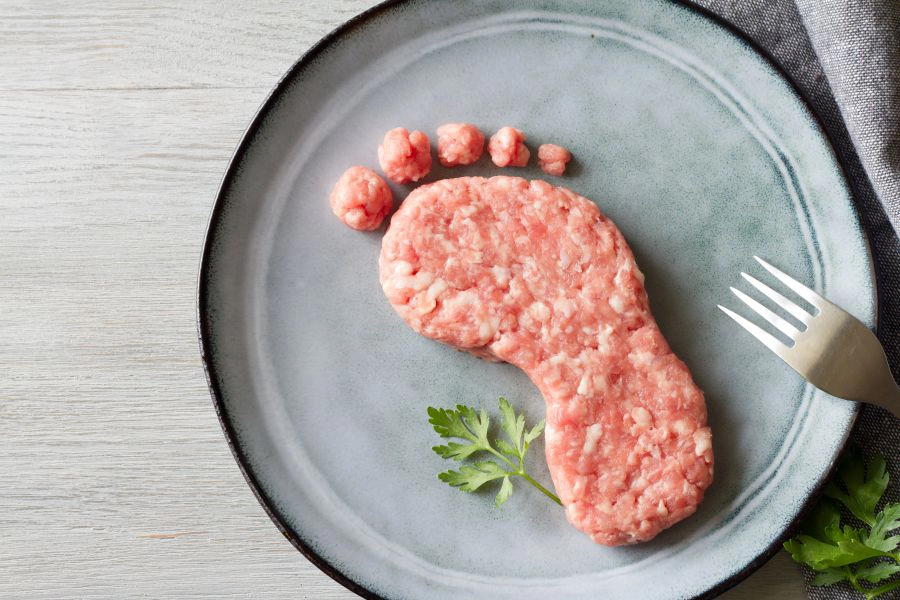 Research shows vegan diets can cut carbon emissions by nearly half compared to omnivorous eating patterns.“You don’t need to go fully vegan to make a difference. Even small steps toward a more plant-based diet reduce emissions and save resources. Every meal that includes more plants helps move us toward healthier people and a healthier planet,” she concludes.
Vegan diet halves GHGE
A separate study in JAMA Network Open finds that a low-fat vegan diet significantly reduces GHGE compared to the standard American diet.
Led by the Physicians Committee for Responsible Medicine, the researchers detail a 51% reduction in GHGE (by 1,313 g CO2-equivalent/person per day) and cumulative energy demand (by 8,194 kJ/person per day) resulting from reduced meat, dairy, and egg consumption.
“As awareness of its environmental impact grows, swapping plant foods for animal products will be as ubiquitous as reduce, reuse, and recycle,” says paper author Hana Kahleova, M.D., Ph.D., director of clinical research.
“We know whole food, plant-based diets are better for our health and the environment,” she adds. “This analysis shows us just how impactful our daily food choices are.”
A recent survey found that nearly half of US citizens would consider adopting a plant-based diet to help reduce GHGE.
“Prior research has shown that red meat, in particular, has an outsized impact on energy use compared to grains, legumes, fruits, and vegetables,” comments Kahleova.
“Our randomized study shows just how much a low-fat vegan diet is associated with a substantial reduction in GHGE and energy use, significant drivers of climate change.”
 Plant-based school meals with fewer meat and fish dishes significantly reduce environmental impact while supporting child health.The team points to the latest EAT-Lancet update, which calls for reduced red meat consumption to lower GHGE, land and water use, and nutrient pollution. Analysts have previously urged removing VAT breaks on meat, which could potentially cut diet-related environmental impacts by up to 6%.
School meal design had 50% reduction in environmental impact
Another study in Science of the Total Environment, looking at Catalan school canteens, found that putting less meat and fish and more legumes and diversified cereals in menus had a 50% reduction in environmental impact.
Sustainable food systems include schools, where pupils can be encouraged to reduce their environmental footprint and improve their health, researchers at the Universitat Oberta de Catalunya and the Barcelona Institute for Global Health suggest.
Schools used the Public Health Agency of Catalonia’s dietary guidelines for schools to design healthy menus for children aged seven to 12, last updated in 2020, taking sustainability into account.
The researchers tout their paper as the first on school menus, acknowledging canteens as places where learning habits can last a lifetime. Additionally, they verify the guideline’s success in reducing 16 environmental impacts, such as acidification, water scarcity, human toxicity, use of mineral resources, metals, and fossil resources.
The team used the 2005 guidelines as a baseline to update in 2012, 2017, and 2020, which reduced the environmental footprint by 9%, 22%, and 40%, respectively.
They found that meat and fish contributed most to the environmental impact and suggested replacing these foods with plant-based protein. Fruit and rice were the main contributors to water usage on farms. While reducing fruit would have a negative health impact, rice can be replaced by other climate-reliant cereals.