


Oral delivery blurs the line between supplement and gray-market peptides


Key takeaways
- CRN says that lawful dietary supplements and gray-market peptides are “worlds apart,” with ingestion the legal dividing line.
- Quicksilver Scientific says its oral liposomal delivery overcomes the bioavailability barriers that have limited ingestible peptides.
- The company cautions that BPC-157 and GHK-Cu human evidence is limited, with much of the excitement resting on animal and practitioner data.
The emerging peptide market is rapidly growing, and so too are concerns about the safety of these short chains of amino acids as consumers and industries grapple with distinguishing them from supplements. The labels on these gray-market peptides often note that the products are not for everyday use or human consumption, yet there are brands using some of these peptides in their oral supplements.
Nutrition Insight previously explored consumers “stacking” gray-market peptides with conventional supplements, as social media biohacking trends drive their popularity. We looked at the blurring of the line between pharma and nutrition, prompting experts to urge tighter regulation and surveillance.

This report examines how US dietary supplements can be better distinguished from gray-market peptides, speaking with the Council for Responsible Nutrition (CRN). Meanwhile, Quicksilver Scientific tells us about its oral peptide delivery technology used in its supplements, which it says enables the company to overcome the common issues linked to gray-market peptides.
CRN, a US dietary supplement and functional food trade association, states that gray-market peptides and lawful supplements validated under the Dietary Supplement Health and Education Act of 1994 (DSHEA) are “worlds apart.”
However, for a consumer who sees “peptide” applied to supplements and injectables, the legal line is challenging to distinguish. A CRN spokesperson clarifies: “Whether injectables contain peptides or any other substance, they do not legally qualify as dietary supplements simply because of their mode of administration. By definition, dietary supplements must be intended for ingestion.”
Oral peptide tech
Quicksilver Scientific says that its oral liposomal delivery technology can overcome the issues linked to gray market peptides, as it contains no compounding pharmacy and is not injection-based.
However, historically, oral peptides have struggled with bioavailability since peptides can easily degrade in the gut.
“Oral delivery of intact therapeutic peptides has historically been limited by two barriers: enzymatic degradation in the gastrointestinal tract and poor epithelial permeability across the enterocyte membrane,” Quicksilver Scientific’s founder, Dr. Chris Shade, tells us. “Liposomal formulation addresses both.”
“We use quality phospholipids like phosphatidylcholine to create our liposomes. Chemistry matters here, and the phospholipid bilayer must be stable and hold active ingredients inside to protect them from enzymatic breakdown.”
Peptide size for better absorption
Shade underscores that the small particle size is essential to enable rapid absorption between and around cell layers, pointing to the company-manufactured liposomes that are under 100 nanometers. The absorption begins in the mouth and the buccal mucosa, through to the capillaries for circulation.
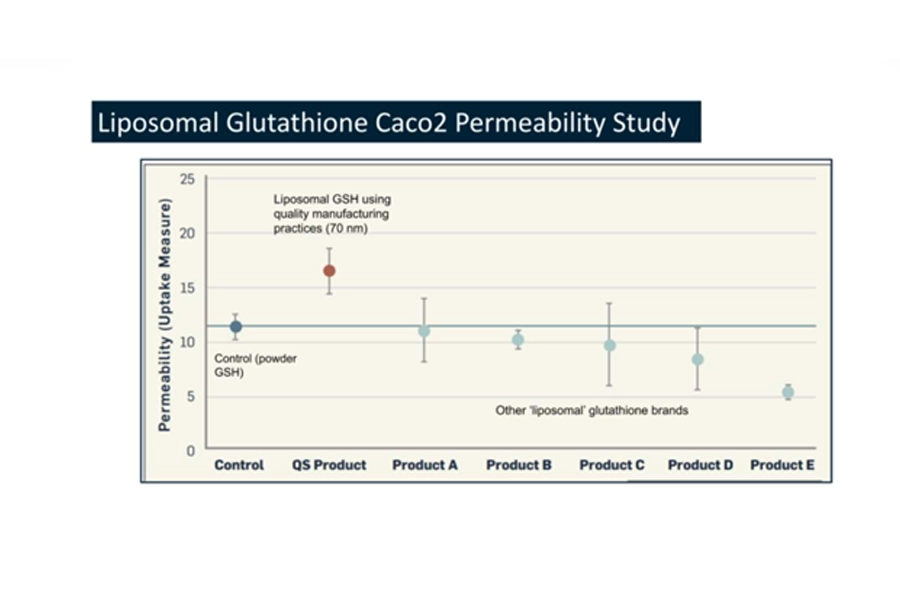 Study results for liposomal glutathione Caco-2 permeability (Image credit: Quicksilver Scientific).“We validated this delivery system originally with glutathione, a tripeptide, starting around 2010–2012, and can compare the success of our glutathione absorption studies to the tripeptide Lysine-Proline-Valine (KPV). It is a proof of concept that liposomal KPV, formulated using the same quality parameters as the liposomal glutathione product used in the above study, will have similar bioavailability and permeability dynamics.”
The company describes KPV as a naturally occurring tripeptide having potent anti-inflammatory and anti-microbial properties.
Furthermore, Shade points to Quicksilver Scientific’s serum uptake studies on ingredients that have similar-sized molecules, such as methylcobalamin (vitamin B12), which is similar in weight to BPC-157 — a synthetic 15-amino-acid peptide, based on a protein fragment that is naturally found in human gastric juice.
Although Shade points to its natural origin, regulators treat BPC-157 as an unapproved drug that cannot legally be sold as a dietary supplement.
“The vitamin B12 uptake shows measurable blood levels in just minutes, offering another proof of concept that BPC-157, delivered in the same liposomal chemistry as the vitamin B12, will have similar results,” says Shade.
“We haven’t yet published dedicated pharmacokinetic trials comparing oral-liposomal BPC-157/KPV directly against injectables — that’s the next research step. Today’s evidence is a delivery-system validation plus the overwhelming number of practitioner-reported use case outcomes. That’s what really counts — but more clinical data is coming.”
Distinguishing from synthetic peptides
Quicksilver Scientific sells its products as nutritional supplements, notes Shade, adding that every peptide used is naturally occurring in the body. “For example, BPC from gastric juices or bioregulators like thymulin and epitalon, which are isolated peptides originating as glandular extracts and have been sold as supplements for decades.”
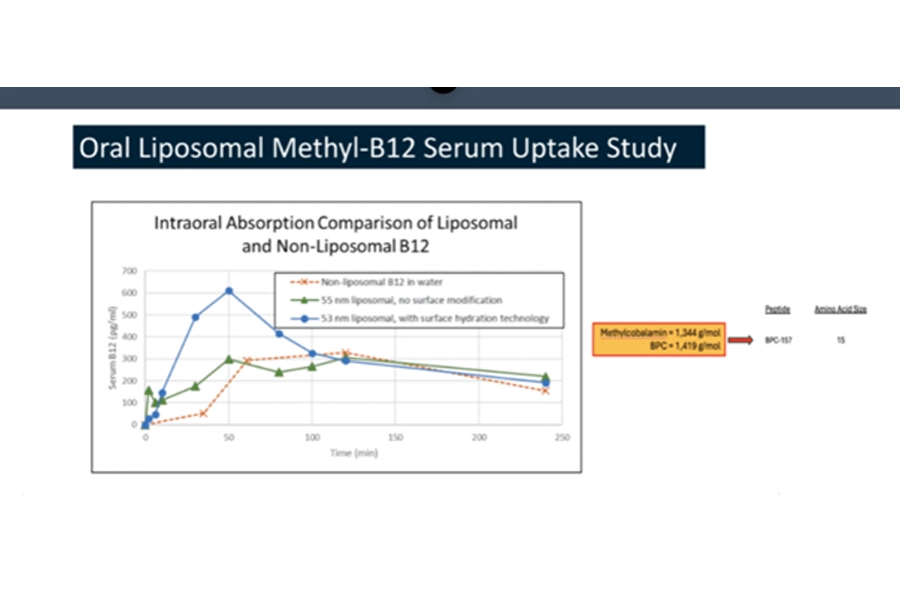 BPC 157 has a similar molecular weight to B12. This uptake study is a proof of concept that BPC 157 in QS liposomal delivery will have similar results, says Shade (Image credit: Quicksilver Scientific).“What we’re doing differently is synthesizing them as pure compounds rather than using crude whole-gland extract. This actually traces back to gerontologist Dr. Vladimir Khavinson’s early ‘bioregulator’ research in Russia, which started with whole gland extracts before the active peptides were isolated and later synthesized.”
Shade emphasizes that the supplements differ from injectables since the company uses a naturally occurring, gland-derived, food-like basis that has a long supplement history.
“Synthetic peptides built to mimic pharmaceutical hormone action, with no natural-source analog, belong in the prescription or compounding channel instead.”
Hype versus science
It has become important to distinguish which peptides are backed by robust science, what remains hype, and which products are approved for human consumption.
Quicksilver Scientific sells three oral liposomal BPC products on its site, carrying a disclaimer that the product “statements have not been evaluated by the US FDA. This product is not intended to diagnose, treat, cure, or prevent any disease.”
BPC-157 is a popular synthetic peptide. Shade explains that in 1993, emeritus professor at the University of Zagreb in Croatia, Predrag Sikiric, discovered that it came out of human gastric juice while studying gut lining repair.
“The preclinical work since then is genuinely impressive: multiple species, tiny doses in the microgram range, effects after a single application, and no toxicity that anyone’s found,” he notes. “Mechanistically, we know a lot: it stimulates fibroblasts and collagen, drives up growth hormone receptors in tendon, brings TNF-α down, and it’s angiomodulatory, meaning it turns angiogenesis up where tissue needs it and not where it doesn’t.”
“The hype is when people turn that into proven human results. The controlled human trials are thin. What’s really driving the excitement is animal data plus a mountain of practitioner-reported outcomes. I take those outcomes seriously (that’s how a lot of clinical medicine actually advances), but it’s not a randomized trial, and I’m not going to pretend it is.”
In an earlier report, researchers warned that little is known about the real-world health effects of many peptides, since they have not been studied in human clinical trials — a gap that Shade echoes as well.
He says it is an overreach to assume that any oral BPC-157 works like an injection. “I think our chemistry gets close. But we haven’t run that head-to-head yet, so I won’t claim it.”
Meanwhile, GHK-Cu (glycyl-l-histidyl-l-lysine copper(II)) is another hyped naturally occurring copper-binding tripeptide found in human plasma, saliva, and urine. It is legally allowed to be used in cosmetics, however, it is not an FDA-approved drug or dietary supplement ingredient. Quicksilver Scientific’s GHK products target topical application and oral intake. Shade says more human data is also needed for this peptide and cautions on distinguishing what kind.
“GHK-Cu is a normal part of human plasma, and levels drop hard as you age. That’s solid. The gene expression work is in human cells: GHK touches around a third of the human genome, thousands of genes. That’s real, and it’s remarkable.”
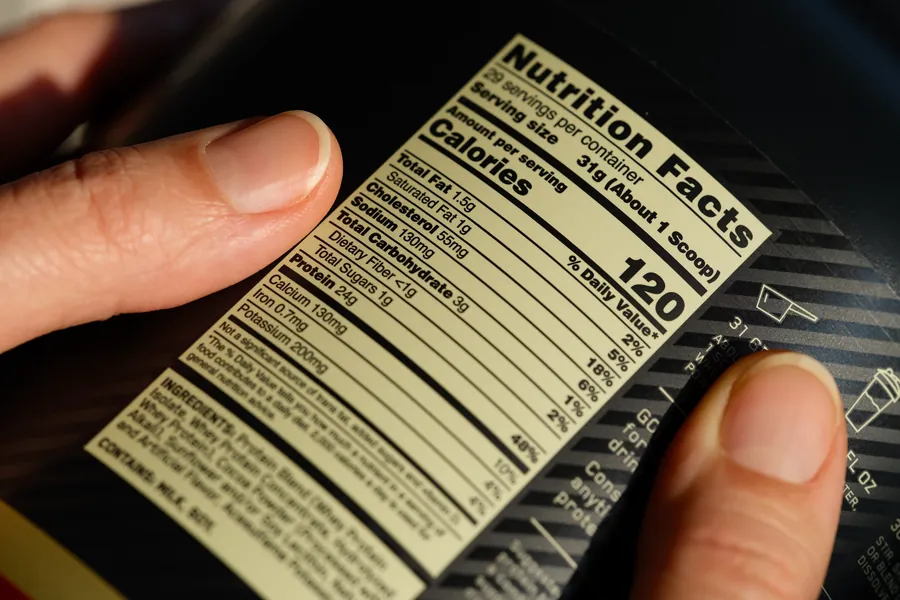 CRN urges that FDA regulations require Supplement Facts panel labels alongside other labeling obligations to help consumers distinguish responsible manufacturers and retailers.“But ‘resets your genome to health’ is a headline, not a finding. What we have is a transcriptional signature pointing in the right direction. The numbers people quote (doubling wound healing and cutting infection by 27%) are from animal studies. The Alzheimer’s findings, the amyloid reduction, and the memory improvements are from mice, too.”
“Exciting? Absolutely. Proven in humans? Not yet,” he stresses.
Distinguishing good actors
It has become challenging for practitioners or brands to know which suppliers are credible from bad actors. “The peptide industry is genuinely the wild west,” describes Shade.
“A lot of what’s sold online is labeled ‘research use only, not for human consumption’ (a legal loophole) with no traceability: you can get a good batch and then a bad one with endotoxin or bacterial contamination, or additives your immune system reacts to.”
“Supplement companies like ours are bound by Current Good Manufacturing Practices (CGMP). We have to test incoming raw material and outgoing potency on every batch. I’ve personally bought a competitor’s liposomal glutathione to test it and found no phospholipids and no glutathione in it at all — just colored water,” states Shade.
In his advice to buyers, he recommends asking for a Certificate of Analysis on a batch, confirming CGMP and GMP certification, while maintaining skepticism of anything priced 30 to 50% lower than established quality brands.
“That gap usually means someone skipped testing. Even compounding pharmacies aren’t automatically CGMP-certified, so ask,” he stresses.
Meanwhile, the CRN spokesperson urges that FDA regulations require Supplement Facts panel labels alongside other labeling obligations to help consumers distinguish responsible manufacturers and retailers.
“Unscrupulous actors may try to skirt these requirements by labeling their products as ‘for research use only,’ and such labels should immediately raise concern. While innovation in the area of peptides presents a great opportunity, companies should ensure they meet all applicable regulatory requirements, whether the peptides are intended for food, dietary supplements, or drugs.”
CRN recently held a webinar, “Next-Generation Peptides: Emerging Science, Innovation, and Opportunities for Dietary Supplements,” exploring peptides’ evolving landscape, science, and opportunities for supplements.