




Researchers develop toolset to enhance digital healthy eating platforms


Key takeaways
- Researchers developed a card-based toolset to help developers create technology that effectively supports mindful eating habits.
- The framework addresses flaws in current apps that rely on stressful calorie tracking instead of addressing emotional and environmental triggers.
- These scientifically grounded cards help designers build safer digital tools that encourage awareness of sensory experiences and internal hunger cues.
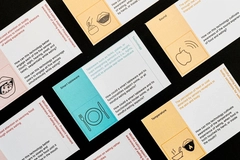 (All image credits: Lancaster University).
UK researchers from Lancaster University have designed a new card deck toolset to guide technology developers who are designing solutions for people struggling with problematic eating habits and unhealthy relationships with food.
The study aims to bridge a critical gap between health science and human-computer interaction, offering designers tools to ensure digital solutions for dieting that are aligned with scientific principles, which makes them safer and more effective.
Nutrition Insight speaks to the authors of the study about their paper published in ACM Transactions on Computer-Human Interaction, which bridges theoretical health research insights and practical design tools.
“Many current mindful eating apps fall short because they focus too much on numbers and not enough on people. They often ask users to track calories or set strict goals, which can feel stressful or even lead to guilt,” explains first author Lala Guluzade, a researcher at Lancaster University’s School of Computing and Communications and a professional app designer.
“At the same time, they overlook the reality that eating is influenced by emotions, habits, and everyday situations, such as stress, social settings, or eating on-the-go. While some apps attempt to support mindfulness or healthy behavior change, they are often not grounded in the most effective interventions identified in health research.”
“As a result, they do not fully support the kind of awareness and understanding that helps people build a healthier relationship with food,” she stresses.
New MEDEC cards
Central to the study are Mindful Eating Design Critique (MEDEC) cards, a new physical tool consisting of a deck of 28 cards developed by the researchers. These translate complex health concepts on mindful eating and offer practical guidelines for designers and health practitioners.
The cards are based on a rigorous analysis of mindful eating principles, interventions, and measurement scales.
When designing the cards, researchers identified the core principles of mindful eating based on a review of existing health science literature on mindful eating principles, measurement scales, and therapeutic interventions.
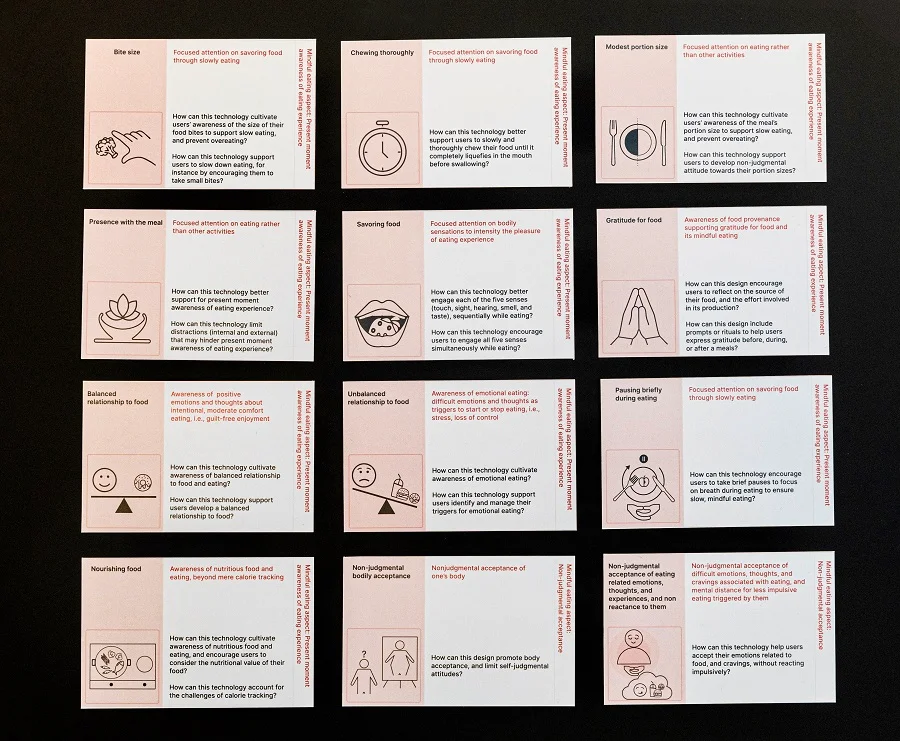 The MEDEC cards consist of 28 cards based on a rigorous analysis of mindful eating principles, interventions, and measurement scales.The cards were then tested and evaluated by 36 mindful eating experts to critique existing technologies, enabling the team to refine the cards.
“The MEDEC cards were created to tackle a simple problem: most technologies, especially mobile apps, are not designed to effectively support mindful eating,” Guluzade tells us.
She says many tools are less effective than they could be as they often don’t cover emotions, habits, and surroundings that shape eating.
“The cards bridge this gap by turning research into practical design ideas, giving developers a clearer and more reliable foundation for creating technologies that genuinely support healthier, more mindful eating.”
The MEDEC cards span various types of technologies, such as mobile apps, wearables, smart tableware, and robots. They also look at different aspects relating to mindful eating, such as taking small bites, chewing slowly, and being aware of different senses and bodily clues.
Limitations to mindful eating
Mindful eating is the practice of being more mentally aware when consuming food and drink, as well as bodily cues such as hunger and feeling full. It is a common technique for cultivating a better, more conscious relationship with eating.
However, the researchers found that many existing technologies have limited theoretical underpinnings from mindful eating research and eating experts.
“Better-designed technology can help people move away from strict dieting and toward a healthier, more balanced relationship with food,” says Corina Sas, professor at Lancaster University’s School of Computing and Communications.
“Instead of telling users what or how much to eat, it can encourage them to notice when they’re hungry, how food tastes, and why they are eating in the first place,” she notes.
“By helping people slow down and reflect, especially during busy or stressful moments, technology can support more mindful, satisfying eating rather than automatic or distracted habits.”
Guluzade adds that the team has carefully refined the deck’s concepts, descriptions, and questions for probing reflection on mindful eating aspects, as well as the cards’ visual design — such as icons and color palette — to make it more accessible for technology designers.
“With problematic eating and unhealthy relationships with food impacting millions worldwide, designing mindful eating technologies based on rigorous science could help people engage with their eating habits more thoughtfully and safely.”