





US states create new ultra-processed food definitions amid federal delay

Key takeaways
- At least 17 US states target UPFs in schools via additives and nutrients, but most miss broad harms, according to a JAMA analysis.
- Massachusetts’ UPF definition matches global science best by targeting factory-made ingredients and meat preservatives.
- California’s definition focuses too much on sugar/salt, which might enable “fake healthy” foods to slip through.

As the US federal ultra-processed food (UPF) definition looms without a national consensus, states are developing their own definitions focused on nutritional value, processing techniques, and select additives.
A new viewpoint by the New York University (NYU), Food is Medicine Institute, and the Tufts Friedman School of Nutrition Science and Policy has analyzed different state UPF definitions. They found that at least 17 states have proposed or passed laws defining UPFs, which mainly focus on school foods. Most also target specific food or color additives but capture only a minority of UPFs, thus having a limited public health benefit.
The JAMA Health Forum viewpoint highlights two definitions. Pennsylvania’s bill aligns closely with Nova and defines UPF as containing ingredients from at least one of nine categories. Massachusetts’ bill aligns with Nova and also includes nitrates and nitrites.

Although the researchers commend the states for attempting to tackle a UPF definition, they expressed concerns about some. For instance, Arizona’s law defines UPFs narrowly depending on whether foods contain 11 additives, which only captures a small subset. California’s law requires foods to include industrial ingredients and be high in sodium, saturated fat, or added sugar — creating a loophole for food companies to reformulate products to meet the nutrient-focused requirements while leaving in other potentially harmful ingredients.
Co-author Jennifer Pomeranz, associate professor of public policy and management at NYU School of Global Public Health, tells Nutrition Insight that the government should closely align the national UPF definition with the Nova framework while including processed meats.
The US FDA also informed us that it is working with the Department of Agriculture as part of a joint effort to develop a uniform definition of UPFs to help consumers improve their dietary patterns and reduce the prevalence of diet-related chronic disease.
California nutrition focus
Pomeranz says that California’s definition was a “missed opportunity” to clearly define UPF.
“California added a second criterion to actively define UPF that was based only on nutrients: to qualify as UPF in California, the product must additionally be high in sodium, added sugar, or saturated fat (or contain sugar alcohols).”
“While many UPFs are higher in sodium, sugar, or saturated fat, others are not. In randomized clinical trials, UPF diets have been associated with overconsumption and weight gain despite being matched on salt, sugar, saturated fat, carbohydrate, protein, and fiber. UPFs that are lower in sugar, salt, and saturated fat are not necessarily more healthful.”
Previous research reports that over 80 cohort studies have linked UPF to harm beyond sugar, salt, and fat.
 Over 17 US states act on UPF definitions amid federal delay.Pomeranz points to examples such as refined starch and protein, UPF breakfast cereals, energy and protein bars, plant-based meat alternatives, savory snacks, and ready-to-eat or heat meals.
“The industry has a history of reformulating UPF to meet nutrient standards, so California’s UPF definition will likely spur new ‘frankenfoods’ — industrially formulated products that meet nutrient targets but are devoid of meaningful nutritive value and contain numerous industrial ingredients,” she says.
Which definition stands out?
The UPF definition in the Massachusetts bill is most closely aligned with Nova. Pomeranz says it captures all “industrial formulations of food substances never or rarely used in kitchens,” and “classes of additives designed to make the final product palatable, appealing, or preservable.”
“The definition further includes nitrites and nitrates, which are not explicitly mentioned in Nova, found in processed meats, and associated with cardiovascular disease, diabetes, and cancer.”
She adds that any UPF definition should include both naturally and artificially occurring nitrates and nitrates as they are found in processed meats that have been found to harm health.
“The Massachusetts bill’s UPF definition most closely reflects the evidence of health harms associated with UPF and processed meat.”
Although the Nova classification system is widely used, researchers and nutritionists have criticized it for being too broad or vague. An expert previously told us that not all category 4 foods, according to this definition, have the same poor nutritional value.
Applying the FDA’s approach
California’s law and Pennsylvania’s bill define UPFs based on the US FDA’s regulations.
The FDA’s definition encompasses select categories such as stabilizers, thickeners, colors or coloring adjuncts, emulsifiers, flavoring agents (adjuvants and enhancers), and nonnutritive sweeteners.
However, the publication points out that although this definition captures relevant additives, it misses other factors that also define UPFs, such as industrial sweeteners, modified proteins, modified oils, nitrites, and nitrates.
The publication notes that, in addition to the FDA UPF definition, Pennsylvania made a policy choice to focus on “unhealthy” UPF. This includes the exclusion of products that comply with the FDA’s regulations for healthy claims, which require minimum levels of healthful food ingredients such as vegetables, fruits, whole grains, dairy, and protein foods, as well as limits on added sugar, sodium, and saturated fat.
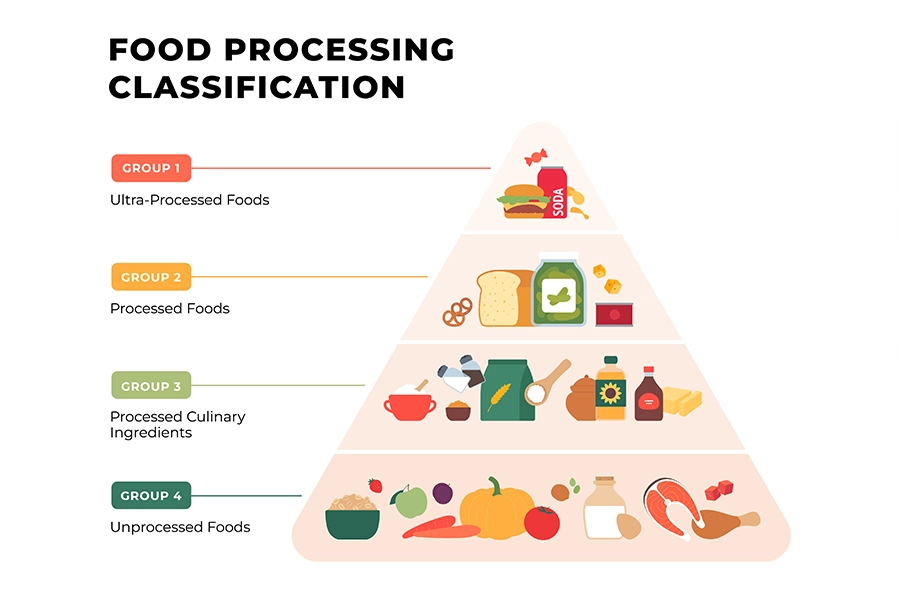 The Nova classification pyramid illustrates foods from minimally processed at the base to ultra-processed industrial formulations at the top.Examining the effectiveness of the healthful approach, Pomeranz says: “We did a separate analysis (in data not shown because it is for a forthcoming paper) where we used the FDA’s ‘healthy’ criteria to evaluate dozens of products and found that most UPFs did not qualify as ‘healthy.’”
“Using nutrient criteria alone would result — and has resulted in — a range of Frankenfoods with just slightly different nutrient profiles, which is why California’s definition is problematic.”
Closing GRAS loopholes
The US has already targeted certain dyes, such as petroleum-based synthetic ones, and pesticides like azoxystrobin, imidacloprid, and boscalid. But to Pomeranz, the issue is much bigger for UPF than specific ingredients.
“There are lists produced by NGOs, for instance, the Environmental Working Group (EWG), about ingredients we know are associated with harm that should be considered for removal from the food supply. Further, we also know evidence has emerged to cause concern about the safety of certain non-nutritive sweeteners.”
“However, the issue in the US is that the food industry has been adding ingredients to the food supply without the FDA or the public’s knowledge. In fact, EWG found that 99% of new ingredients enter the food supply through what we call the Generally Recognized as Safe (GRAS) loophole.”
She explains that the FDA has permitted the industry to self-affirm the GRAS status of many compounds without notifying the FDA. Companies can claim food ingredients are safe based on in-house assessments. Meaning there are various ingredients we do not even know about, and that may be harmful, adds Pomeranz.
“The FDA needs to close the GRAS loophole, require disclosure of all ingredients the food industry has added to the food supply, and evaluate them all for health and safety.”
Last year, Health Secretary Robert F. Kennedy Jr. directed the US FDA to explore how to eliminate self-affirmed GRAS. Researchers noted that the FDA’s post-market review of ingredient safety is limited by insufficient resources, often completed decades after an ingredient’s safety is questioned.
However, the Alliance for Natural Health urged a balanced approach without the complete elimination of self-GRAS, which would create a massive regulatory bottleneck, potentially removing thousands of safe ingredients from the market along with those that are unsafe.
In other developments, scientists are calling out health-harming corporate tactics — the manufacturing and marketing of UPFs — urging tobacco-like tactics to curb the 2.3 million related annual deaths from UPFs.