



Jungbunzlauer backs bioavailable magnesium bisglycinate for gummy and liquid formats


Key takeaways
- Jungbunzlauer positions chelated minerals as bioavailable solutions for gummies, liquid shots, and GLP-1 companion formulations.
- The company’s magnesium bisglycinate combines bioavailability with tolerability across gummy, liquid, and capsule supplement formats.
- Jungbunzlauer’s citrate mineral range minimizes gelling-agent interactions for magnesium, calcium, and zinc gummy supplement applications.

Amid growing consumer interest in magnesium for various health areas, Jungbunzlauer highlights the benefits of chelated minerals for bioavailability across different product formats, such as increasingly popular gummy supplements or functional food and beverages. The company derives these organic compounds or mineral salts from citric, gluconic, or lactic acid through fermentation.
Innova Market Insights data indicates that magnesium is one of the top ingredients in supplements for insomnia or brain-mood health, accounting for 23% of global supplement launches with these claims between April 2025 and March 2026.
Nutrition Insight meets with Agata Möllerhenn, strategic marketing product manager at Jungbunzlauer, to discuss the opportunities of chelated organic minerals and the formulation challenges these ingredients help to overcome.

She says that chelated organic minerals are increasingly valued because they’re highly bioavailable and compatible with many supplement formats.
“In general, the effectiveness of nutritional supplements doesn’t only depend on the dosage, it also depends on how well the nutrients are absorbed by your body and how well our bodies tolerate the mineral salts.”
She underscores that poorly absorbed minerals can limit an ingredient’s benefit for consumers. “If you don’t see any benefits, you won’t take it any longer. As humans, if we do something, we want to get a benefit out of it. If we don’t see it, we won’t stay with the product.”
Moreover, she highlights the importance of providing ingredients with “predictable absorption” and consistent taste in an end product.
In response to the growing demand for bioavailable magnesium formats, Jungbunzlauer recently launched a fully reacted magnesium bisglycinate, which it engineered to deliver optimal absorption and superior tolerability. This ingredient is produced by a complete conversion of glycine with a magnesium source, using citric acid for stabilization and subsequent crystallization.
Beyond pills and capsules
Jungbunzlauer observes a growing pill fatigue on the market. Möllerhenn notes that consumers want to “add sensation” to their supplements, going beyond capsules and tablets.
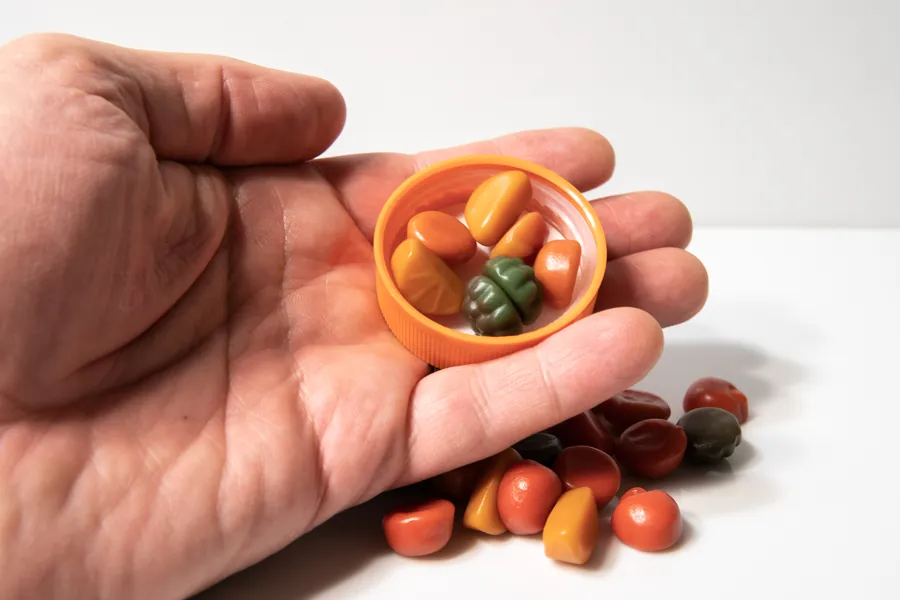 Jungbunzlauer offers its mineral citrates for gummies, as these have almost no interaction with gelling agents and high bioavailability but don’t affect a product’s taste.“They want to align their stacking habit with their supplement habit and combine them. That’s why we’ve seen that new formats and new concepts are needed.”
New formats, such as gummies or wellness shots, combine health benefits with an experience, she highlights. “It’s not that you’re ill and you need to take a pill or capsule — it’s that you want to treat yourself.”
For example, at this year’s Vitafoods Europe trade show, Jungbunzlauer presented its magnesium bisglycinate in a liquid format, providing 100% of the recommended daily intake of magnesium in a 25 mL shot.
Möllerhenn explains that the company combined the mineral with citric acid to counteract its bitter and fishy aftertaste.
“This is a nice concept to showcase what sets us apart. We’re not only delivering the magnesium bisglycinate to our customers — we’re helping with reformulation if customers have an issue with the flavor.”
Gummy formulations
Möllerhenn says Jungbunzlauer has done various trials with its minerals to determine how they function in chewables and gummies, which are increasingly popular supplement formats.
 Möllerhenn says supplement effectiveness depends on an ingredient’s dosage, absorption, and tolerability.“The problem with supplements in gummy form is that they need to be tasty, because otherwise, nobody will take them. You can have the nicest-looking gummy, but if it’s not tasty, consumers will not take it on a regular basis. Then you come back to pills and tablets.”
Because Jungbunzlauer conducts trials with different gelling agents, she says the company can recommend the right pectin or gelatin to its customers.
“If you use them wrong, they don’t set — they’ll interact with the ions, and then you won’t get a gummy; you’ll get a mess, or a gummy that’s hard as rock.”
Moreover, Möllerhenn says that gummies need to integrate large amounts of mineral powder into a small gummy to deliver a meaningful amount for a health benefit so that brands can make a claim on a product. Additionally, she underscores that ingredients need to be evenly distributed throughout the gummy and disperse easily.
“You have to choose the right particle size to avoid interaction with the gelling agent — if you choose the wrong one, you’ll get a very sandy mouthfeel,” she details. “Therefore, you need to choose a micronized version, a small particle.”
“We use our citrate range for magnesium, calcium, and zinc, because we’ve seen that their interaction with the gelling agents is almost nil. They’re very good and work well with gummy bases. The citrates are well known as organic, so the bioavailability is very high. If you consume only two of our gummies, you’ll already have a significant amount of your daily needs, and it can be absorbed by the body.”
Möllerhenn adds that the taste of Jungbunzlauer’s citrate minerals is “almost non-existent,” meaning that brands can use a high dose without affecting a gummy’s taste.
GLP-1 support
In addition to a growing demand for new delivery formats, the rise of GLP-1 medications is driving a shift in the nutrition, food, and beverage industries. Although Jungbunzlauer doesn’t produce GLP-1 companion nutrition, Möllerhenn highlights how the company supports its customers in targeting these consumers by addressing formulation-specific challenges, such as off-taste, texture, and mineral fortification.
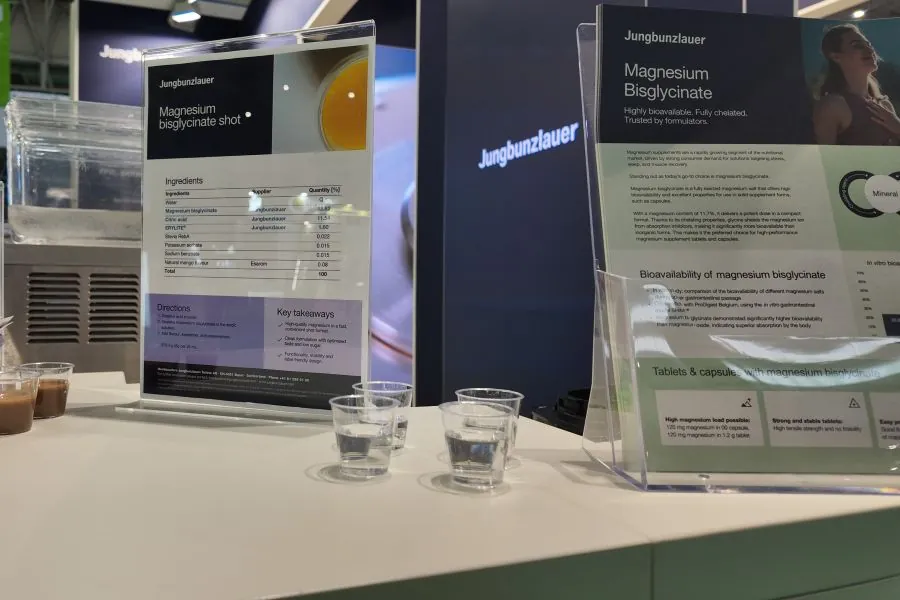 At Vitafoods Europe 2026, Jungbunzlauer presented a 25 mL shot with magnesium bisglycinate, delivering 100% of the daily intake.She says that GLP-1 users are highly demanding customers because they eat less but still need to obtain the same amount of nutrients, such as minerals, from smaller portions. Moreover, consumers seek low-sugar options, but with a good texture and taste.
“Products targeting metabolic health and GLP-1 users place very specific demands in taste, texture, and nutrients,” she adds. “The role of Jungbunzlauer is to help our customers balance nutritional density and sensory acceptance, using natural ingredient solutions.”
“If you formulate with minerals, it’s always a challenge — taste-wise but also texture-wise,” Möllerhenn highlights. “The texture becomes harder to manage in a reduced sugar system: there is a risk for a thinner mouthfeel, chalkiness, and instability, none of which you want. And fortification is more complex, because you need the nutrients to remain stable and bioavailable, with a good sensory profile.”
She says Jungbunzlauer aims to solve these challenges through functional ingredients, such as organic acids, its sugar replacer Erylite erythritol, and textured systems, e.g., combinations of xanthan gum or gellan gum.
Future of chelated minerals
According to Möllerhenn, consumers are becoming more educated as they can inform themselves with AI. “They know organic or fully reacted mineral salts are the minerals best absorbed by the body, so they search for that.”
“They also need to feel the benefit — and they need to feel it now, not in two weeks, because that’s too long.”
Since consumers are increasingly looking for new, innovative formats they can easily integrate into their lifestyle, she says that Jungbunzlauer will continue to work on new format concepts, as this will become more important. “We need to make great-tasting products that can be consumed on-the-go, and something they can tell their friends and co-workers about.”
“We believe that if the product tastes good, the consumer will take it tomorrow and the day after, and then they will feel the benefit. Minerals work over time — people who don’t feel it now will feel it once they’ve taken it for a while — but we need to bridge that gap until the consumer gets the benefit,” Möllerhenn concludes.