



Scientists develop “living sensor display” that turns skin into a health monitor

Key takeaways
- Japanese scientists have created a “living sensor display” by genetically engineering skin cells to glow green when they detect internal inflammation.
- The system is self-regenerating and battery-free, using the body’s natural skin turnover to provide continuous monitoring for over 200 days.
- This adaptable technology offers a visual alternative to blood tests and could eventually monitor various metabolic cues in both humans and animals.

Japanese scientists have introduced a “biohybrid” health monitoring system that engineers the skin’s surface to visibly indicate the health status inside the body by signaling when inflammation is present. This comes at a time when external wearable devices used to track health, such as smartwatches, have grown in popularity.
The joint research group, led by Tokyo City University and the University of Tokyo, in collaboration with Riken and Canon Medical Systems, calls the innovation a “living sensor display.” This engineered skin graft fluoresces in response to specific biomarkers.
The system uses the body’s natural skin regeneration to support long-term biomarker monitoring, producing a visual readout without blood sampling after implantation and allowing for observational assessments.

“Conventional approaches are often invasive or provide only snapshots in time,” says professor Hiroyuki Fujita of the Tokyo City University, who is also professor emeritus at the University of Tokyo. “Our goal was to explore a biologically integrated system that enables continuous sensing and intuitive interpretation, even at home.”
Genetically engineering skin cells
Typically, systems that monitor internal biomarkers — such as proteins that indicate inflammation, stress, or disease — are based on blood sampling or external sensors that operate for limited durations.
In creating the living sensor display, the research team genetically engineered epidermal stem cells to respond to inflammatory signaling, specifically the activation of the NF-κB pathway, key for regulating immune and inflammatory responses.
Because these living epidermal stem cells are self-regenerating, the living sensor display is maintained through the skin’s natural turnover.
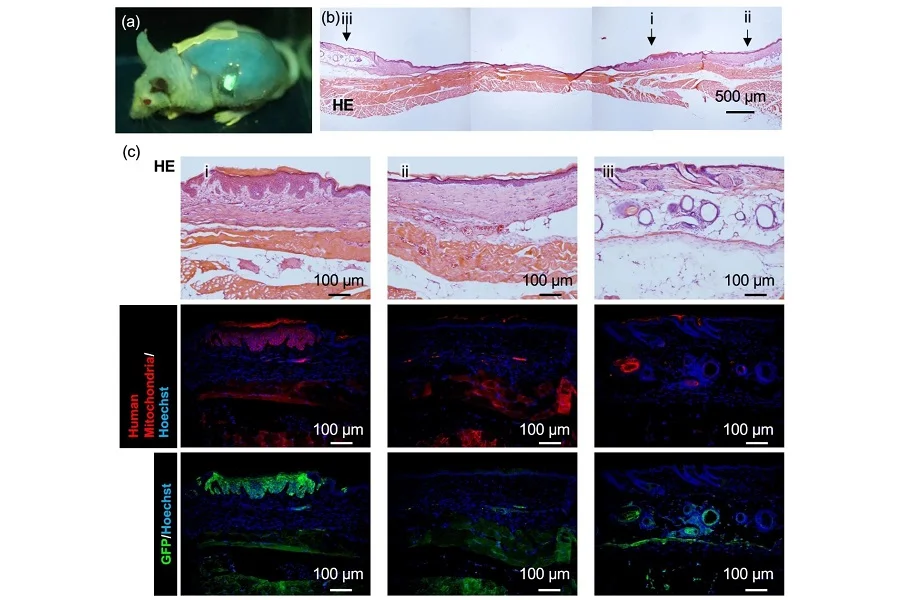 TNF-α responsive tissue-engineered skin engrafted on a mouse (Image credit: Nature Communications).This newly generated skin tissue gives off a green fluorescent protein in response to inflammation-related signals.
“Unlike conventional devices that require power sources or periodic replacement, this system is biologically maintained by the body itself,” explains professor Shoji Takeuchi at the University of Tokyo.
“In our experiments, the sensor functionality was preserved for over 200 days, as the engineered stem cells continuously regenerated the epidermis.”
When transplanted on mice, the engineered skin engrafted and functionally integrated with the host tissue. The scientists induced inflammation, which triggered this grafted area to emit a green fluorescence.
Long-term evolution
The study, published in Nature Communications, offers potential long-term biologically integrated use without the need for batteries, wiring, or active user operation. And while this work focuses on inflammatory signaling, the underlying strategy is “adaptable,” add the researchers.
“By modifying the molecular targets, similar engineered skin constructs could be designed to respond to other physiological or metabolic cues,” they note.
They also reveal that this technology might have applications beyond human healthcare, including those in animal research and veterinary medicine. In these instances, visual indicators of health status could aid the early detection of disease among animals who cannot communicate symptoms.