



Color-coded nutrition labels linked to healthier consumer food choices


Key takeaways
- Color-coded labels beat traditional nutrition tables — red for high fat or sugar triggers stronger “negative bias” to pause unhealthy purchases.
- The study shows that colors are processed faster in the brain than text, leading to more consistent healthy choices regardless of nutrition knowledge.
- With obesity tripling in US youth, traffic-light systems like the UK’s emerge as simple public health tools.

Research has found that color-coding food product labels is more effective than traditional nutrition tables in influencing consumer dietary choices. The paper suggests that color coding can play an essential role in shaping public health and guiding healthier choices amid rising obesity levels.
Color-coded labels help the brain’s processing of dietary information by indicating nutrient levels, according to the scientists at SWPS University, Poland, and the US-based University of Wisconsin and the University of Massachusetts.
In the study, participants rated products with color-coded labels, showing that negative cues, such as red for high fat or sugar, significantly impacted consumer behavior. The researchers note that the consumer behavior was more consistent than traditional labeling.

Urgency and existing models
SWPS University notes that US children and adolescents who are obese and overweight or at risk of becoming overweight have more than tripled over the past 30 years, reaching 37% and 34%, respectively. The main drivers of this trend are reductions in physical activity and overconsumption of foods high in fat and sugar.
In Europe, color-coded labels are increasingly used to encourage healthier consumer food choices. The colors indicate nutrient levels relative to percentage reference intakes (RIs) for calories, fat, saturates, sugar, and salt.
In the UK, for instance, the “traffic light labeling” system shows the nutrient levels that products have. Foods with less than 15% of the reference intake are coded green, while those over 25% are red.
Participant evaluations
Investigating the psychological mechanisms behind the color-coded product labels, the findings aligned with previous research that showed images are easier to process for consumers than text. The new study showed the same effect with colors, as they require little effort by the brain, and decisions can be made more instinctively.
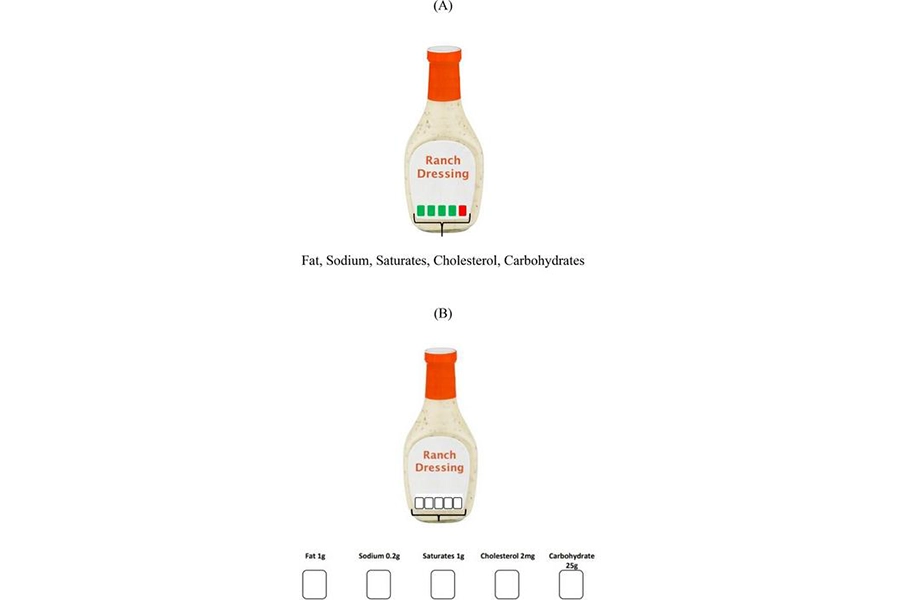 An example of (A) ranch dressing with a color-coded label and (B) ranch dressing with traditional labeling (Image credit: Falkowski).The scientists recruited 79 participants from the US Amazon’s Mechanical Turk platform to evaluate the healthiness of various food products, such as chicken noodle soup, ranch dressing, and peanut butter.
The products had either color-coded ingredient quantities, using only red and green, or traditional front-of-pack text on the packaging.
The participants rated the products using a provided set of adjectives on a scale from zero to 10, from harmful to healthy.
Red brings impact
The Current Psychology study reveals that the color red, indicating high fat or sugar, has a much stronger impact on consumers than green, which reveals the positive aspects of a product.
The researchers add that the positive-negative asymmetry was not clear in traditional nutritional labeling, where consumers struggled to identify benefits from threats.
“This result also aligns with existing theories suggesting that negative events exert a stronger influence on behavior than positive ones,” says study author Professor Andrzej Falkowski, a business psychologist from the Institute of Psychology at SWPS University.
“It is this ‘negative bias’ that makes color systems so effective. Red causes us to pause and reconsider a purchase.”
Furthermore, the researchers explain that when consumers view color codes, they evaluate products more consistently than traditional labeling, as they can clearly identify benefits and risks. Traditional information, such as “low fat,” is often unclear, while colors make it clear for everyone regardless of their level of dietary knowledge.
“Given the ongoing global challenges of obesity and poor dietary habits, color-coded labeling represents a simple yet impactful strategy for guiding healthier consumer choices,” says Falkowski.
In related news, researchers designed a nutrition label that can better help consumers identify healthier options than the US FDA’s proposed Nutrition Info Box label. The new labels carry a simplified design with “high in” printed on product packaging with excess saturated fat, sodium, and added sugar levels, suggesting health risks.
Previously, a coalition of consumer, public health, and nutrition groups, along with academic researchers, advocated for a mandatory, interpretive labeling system that would highlight levels of added sugars, sodium, and saturated fat in packaged foods.
Moreover, research suggested that the FDA’s nutrition info box works best for consumers with high nutrition literacy, widening the understanding gap.