

- Industry news
Industry news
- Category news
- Reports
- Key trends
- Multimedia
Multimedia
- Journal
- Events
- Suppliers
Suppliers
- Home
- Industry news
Industry news
- Category news
- Reports
- Key trends
- Multimedia
Multimedia
- Events
- Suppliers
Suppliers
Chr. Hansen talks non-alcoholic innovation and the future of fermented beverages
14 Sep 2022 | Chr.Hansen
Nathalia Edwards, commercial development manager, fermented beverages at Chr. Hansen, examines some of the key trends emerging at Drinktec 2022. She also details the company’s solution, NEER Yeast, for making non-alcohol beer and looks at future innovations in fermented beverages.
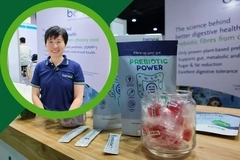
This is Joshua Paul, reporter from Drink Tech 2022.
I'm here at the Christian Hansenstein with Natalia Edwards, who is commercial development manager for fermented beverages.

Welcome.
Thank you.
So, as a first question, what are some, what are some of the key trends that are emerging here at the show regarding beverage innovation and technology as we go into this last phase of the year?
You know, this is one of the biggest trade shows that is within the drink sector, so it, it covers a lot.
We're going from packaging equipment, ingredients, and us covering fermentation.
But of course people are still here, they're eager eager actually to innovate now after the COVID, they're ready.
Sustainability gets brought up by a lot.
And we of course, but maybe we're a little bit biased from where we're sitting, hear a lot of interest in developing on the non-alcoholic space as and what can be done there.
OK, and what exactly are you showcasing today in that space?
Yes, so our flag flagship product you can.
Is the near yeast, which is the pique Kluberries, which is really a fast, sustainable and cost efficient solution of making non-alcoholic beer.
Where you're using a yeast to ferment the beer, and we can brew it all the way down to 0.0.
And make a lovely tasting beer from that.
OK.
And what can we expect to see in the future in terms of fermented beverages?
How are you looking to innovate further?
Yes, so I would say the key focus for us really is at the moment lying very much on this adult beverages, non-alcoholic and fermented, because we do believe.
That fermentation is key to creating great flavors, interesting products, and that's also what we see if we look in history, you know, Successful adult beverages are fermented, so to be successful in this adult range here for non-alcoholic, we believe that fermentation really is needed.
When that is said, of course, we also work on optimizing production.
Er that's always top of mind, so we will never innovate and find a new product that will make life harder for the beverage producer or the brewery.
It's always to solutions that will optimize and make things easier.
So we're also coming here with some new yeast for ale and lager, which is more, you know, focused on optimizing the project, the process.
OK, and so what sorts of like social drivers do you think are pushing the er the trend towards non-alcoholic beverages?
Oh, many, depending on who you're asking, of course.
Health is a big topic of a lot of people, but it is interesting to see there's also the young people driving it very much.
They are more health conscious but not.
Not in an extreme way, it's more of a holistic way of living that you may not always want to consume alcohol.
So just having this balanced life, and that's kind of really rubbing off on the whole of society, it's more about balancing, it's not going to the extremes.
And one of the reasons that they now want the non-alcoholic beer to actually taste like the real beer, so an IPA should taste like an IPA.
OK, and you've already touched on this slightly, but I do you think consumers have a greater understanding of the, the health benefits of fermentation, for instance, on their gut's health and er how a healthy gut plays into things like immunity, mood, the gut brain axis, and so on.
That's a really good question, because fermentation is core of everything we do, and we've been investigating.
Do people understand fermentation?
Do they get the value of it?
It is growing slowly, and I actually do firmly believe that it's going to grow more because people are noticing the health benefits.
It's actually that they are seeing first.
They're hearing about, oh, this is fermented, it's healthy, or they hear about probiotics.
So I think the general knowledge on that is growing and that's going to rub off on everything fermented having kind of an appeal.
So that's actually one of the reasons we have recently started a new project where we are part of a big project called Health Firm funded by the European Union where we're actually going to look at different fermentation solutions.
And carry it through into the making some actual products and seeing how does that impact gut health and wellbeing in general.
So we're looking at it in the future for us it really is the future to know the health value of fermentation, and we're working on it in this big project with a lot of partners.
That's brilliant, Sonia, thanks for your time.
You're welcome.