

Promotional banner with text about biosolutions for gut health, featuring a smiling person and a “See all products” call-to-action.
Home
Videos
Bioiberica CEO on su...

Bioiberica CEO on sustainability milestones in 50-year history

18 Jun 2025 | Bioiberica

At Bioiberica’s leading manufacturing site in Palafolls, Spain, we examine key milestones in the company’s 50-year history with its CEO, Luis Solera. He highlights how sustainability and the company’s circular economy model are the foundation of the company’s manufacturing process. Solera details how Bioiberica moved from using 0.01% of raw materials for its anticoagulant heparin to valorizing over 90% of materials with solutions for humans, animals, and agriculture. In the future, he aims to improve sustainability, such as water reuse, and leverage 100% of raw material sources.
This is Yolande van Gaal from Nutrition Insights.

I'm here at Biobirica with Luis Solera, who is the company's CEO.

Thank you for joining us today.

Thanks for coming.

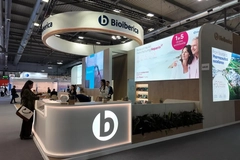
And we already see behind you 50 years of Bioerria.

Congratulations.

Thank you very much.

Can you walk us through some of the key milestones in Bioirrica's history?

I think the main milestone is when it started.

I think Dr.

Villa, the founder of the Company, he was a pure visionary.

I think he's the one who from the beginning he said, when we are producing heparin at the end we are only using 0.0.1% of the initial raw material, and then what are we going to do with the rest.

So with the rest we had two options either treat it as a waste or try to valorize it over time in order to bring it into the market with new products, and I think that is what the different milestones that have been in the company has been the process of being able to valorize until now, nowadays in which we.

Is 90% or more than 90% of that raw material that enters into the factory.

And another thing that's very important is your circular economy model.

Can you explain a bit how it looks and also how it influences your manufacturing processes?

Definitely, I think it is.

It is the foundation of the process that we have.

When we talk about the circular economy, we start with the raw material.

The raw material comes from an animal which it is a slaughtered in a slaughterhouse.

That raw material, we bring it over here and as I said, you know, like maybe only a small percentage becomes the API that it is used for human consumption.

The rest of the raw material, then we use it in different applications, always backed up with science.

What we have done is developed products for animal nutrition or for biostimulants for agriculture.

These animal nutrition products at the end they go to feed the animals in their early stage to ensure you know that the growth is proper and in many ways to limit the amount of antibiotics that are used in these animals and later on these animals again feed on the raw material that the Biorica uses.

And when it goes to agriculture, it is the same thing we do biostimulants which allow the plants to grow farther.

And sometimes also to decrease the level of chemicals that are used in order to grow these products, and at the end, these products, at the end they are either being used to feed the animals or to feed the humans.

So at the end of that circular economy, it is constantly evolving.

OK, and can you talk a little bit about your future goals for Bioerica in terms of sustainability and circular economy practices?

We have to improve as much.

I said, we are reusing now around 90% of the raw material.

We want to get to the 100%.

And I think it is, it is, the farther you go, it gets tougher, but we are still, you know, aiming for that.

And I think in the meantime, you know, I think the good thing about sustainability is that it gives you parameters which are very much alike on the way we measure the productivity that we have.

So of course, you know, like the reuse of the water that we have, which nowadays it is around 30%.

In our process, we want to increase it somehow.

We use solar panels already in our factories in order to have like a clean energy, but all this at the same time, you know what they are, it is contributing to this productivity that we have, which also ensured the sustainability not only of our plants as such, but also of the business long term.

OK.

And I know something that we've talked about already is collaboration, how important that is for Bioe.

Can you explain a bit how collaborating over regulatory, scientific, and industrial domains helps accelerate the development of new life science products?

I think it is definitely very, very important.

I think we are part of the value chain.

You know, an important part of the value chain, but we have to collaborate also with those companies which are ensuring that the final product that is in the market, as as with that part of the value chain which it is ensuring that the traceability of the raw material, it is reaching to us.

I think if you talk, if you work regulatory wise, sustainability wise, everything with all the value chain, at the end it is when you are creating more security and healthy process throughout the value chain, and I think that is our aim.

I think we know we are responsible for a big part of the value chain, but we cannot avoid the responsibility upwards and downwards in that value chain, and that's what we are trying to ensure constantly.

Awesome.

And finally, I would love to start to see what you what you envision the role of Biorica to see to be in the broader life sciences ecosystem over the next decade.

Wow, looking into the future.

Yeah, I think, I think if we look back only 10 years ago, Biorica has been developing big time.

And we know already where do we want to reach in 10 years from now, which it is following the path that we have been initiating or we initiated a long time ago.

We are already in the process of developing new products, new categories, and in all this development, the key thing again, it is to ensure that this circular economy model, you know, is implemented.

So maybe we will not go as fast as we will like, but what we are going to ensure is that this path is going to be in the way that ensures that circular economy that we have.

So I think in 10 years from now we will continue to be the America that we are now, but much bigger, much larger, and coping with many other categories as we have today.

Awesome, thank you so much.

Thanks a lot.

More videos

Image