



Dry, bitter foods awaken the brain, delivering exercise-like benefits through astringent flavanols


Key takeaways
- Flavanols stimulate the brain via sensory nerves and the gut-brain axis, even though they barely enter the bloodstream.
- Mouse data show immediate boosts in dopamine, norepinephrine, learning, memory, and exploratory behavior — similar to exercise-induced stress responses.
- Findings open pathways for next-generation foods that leverage taste-driven neural activation rather than bioavailability alone.

A Japanese study has found that astringent tastes can directly signal the brain, triggering effects similar to a mild workout for the nervous system. The sensation, caused by flavanols via the gut-brain axis, may lead to future applications in sensory nutrition, especially for next-generation food formulas.
Researchers at Shibaura Institute of Technology conducted mouse experiments, in which flavanol was found to boost activity, curiosity, learning, and memory, despite not entering the bloodstream.
They explain that sensory stimulation activates brain pathways associated with attention, motivation, and stress.
Foods rich in polyphenols, making them astringent, include cocoa and berries. Polyphenols, including flavanols, can cause a dry, rough, or sandpaper-like feeling in the mouth and have been linked to lower cardiovascular disease.
Unveiling the flavanol mystery
The researchers explain that, because flavanols are poorly bioavailable, the mechanism by which they promote healing has remained unclear until now.
There is a research gap on flavanols, as there is little knowledge about how they impact brain function and the nervous system, since they are poorly absorbed. Industry developments advancing the bioavailability gap in botanicals are in focus at Activ’Inside.
“Flavanols exhibit an astringent taste. We hypothesized that this taste serves as a stimulus, transmitting signals directly to the central nervous system (comprising the brain and spinal cord),” says research lead Dr. Yasuyuki Fujii.
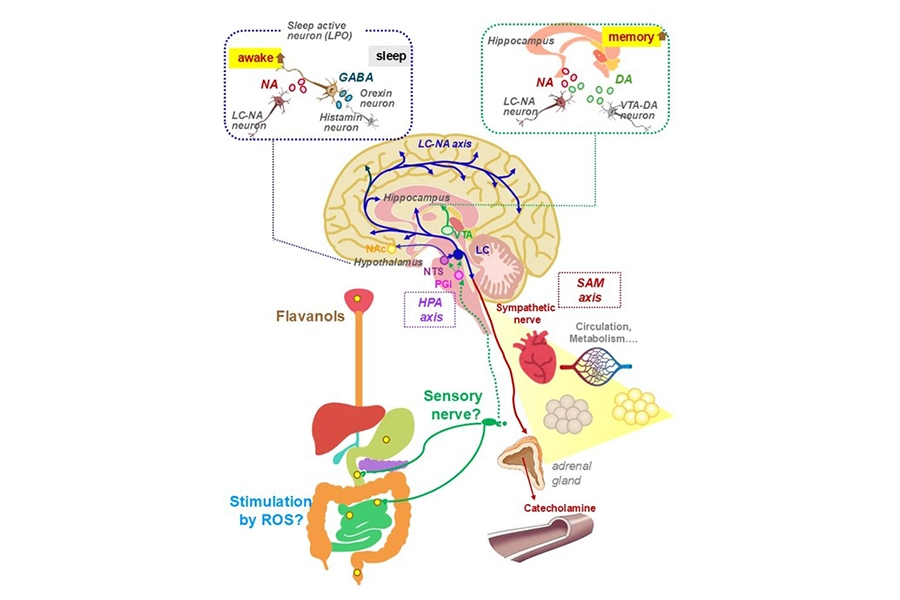 (Image credit: Dr. Yasuyuki Fujii).“As a result, it is thought that flavanol stimulation is transmitted via sensory nerves to activate the brain, subsequently inducing physiological responses in the periphery through the sympathetic nervous system.”
Dopamine boost
The study in Current Research in Food Science used 10-week-old mice that were given 25 mg/kg or 50 mg/kg of flavanols per body weight. The control group was only given distilled water.
The researchers found that flavanol-fed mice showed more motor activity, exploratory behavior, and improved learning and memory compared to controls.
They explain that the mechanism worked by enhancing neurotransmitter activity in the brain. Flavanols increased dopamine, its precursor levodopa, norepinephrine, and its metabolite normetanephrine. These effects were immediate after administration.
According to the researchers, dopamine chemicals regulate motivation, attention, stress response, and arousal.
Mechanisms mirroring exercise
Additionally, flavanols boosted the signaling capacity of the noradrenergic system, a group of nerve cells that control alertness and emergency responses. Specific mechanisms involve the tyrosine hydroxylase and dopamine-β-hydroxylase enzymes, as well as the vesicular monoamine transporter 2.
Researchers added that they found that the mice had high urinary catecholamines, which are hormones released when stressed. They also found increased activity in an area related to stress — the hypothalamic paraventricular nucleus (PVN). Lastly, flavanols boosted a key transcription factor and corticotropin-releasing hormone levels in the PVN.
These findings indicate that consuming flavanols can trigger several physiological responses, which are similar to those induced by exercise.
“Stress responses elicited by flavanols in this study are similar to those elicited by physical exercise. Thus, moderate intake of flavanols, despite their poor bioavailability, can improve health and quality of life,” says Fujii.