



Appendix removal raises Alzheimer’s risk, but dietary shifts may restore gut protection


Key takeaways
- Appendectomy links to a higher Alzheimer’s risk, as it acts as a beneficial gut bacteria reservoir, leading to microbial imbalances, according to research.
- Plant protein, whole foods, dairy, and omega-3 diets predict lower risk while processed foods raise vulnerability.
- Fermentable fiber and fermented foods may restore short-chain fatty acid producers to protect the gut-brain axis against neurodegeneration.

Researchers have found a link between people who have had their appendix removed and an increased risk of Alzheimer’s disease. They speculate that the organ connected to the large intestine acts as a reservoir of beneficial gut bacteria and, with its absence, leads to key microbial losses.
Nutrition Insight speaks with the project lead to learn about the role of dietary patterns and strengthening the gut-brain axis to potentially lower Alzheimer’s risk.
Over 55 million people worldwide are affected by Alzheimer’s, which is expected to almost triple by 2050, the team underscores. The disease is long thought to be something that happens in the brain — from slow accumulation of toxic proteins or eventual loss of neurons.
However, the transdisciplinary study by the University of Technology Sydney in Australia and Massachusetts General Hospital of Harvard Medical School in the US suggests looking for answers in the gut.
Secrets of the appendix
The study in Alzheimer’s & Dementia Diagnosis Assessment & Disease Monitoring found that appendix removal raised Alzheimer’s risk the most. The researchers tout the multi-modal machine learning study as one of the largest of its kind.
The AI was trained on data from nearly 10,000 people, while the researchers analyzed over 120 everyday factors, including diet, medical history, gut bacteria, and lifestyle, to determine which had the strongest link to Alzheimer’s risk.
Dr. Faezeh Karimi, senior lecturer at the University of Technology Sydney’s School of Computer Science, tells us that although the link between appendix removal and Alzheimer’s risk does not imply causation, it might reveal the appendix’s potential role in supporting long-term gut microbial stability.
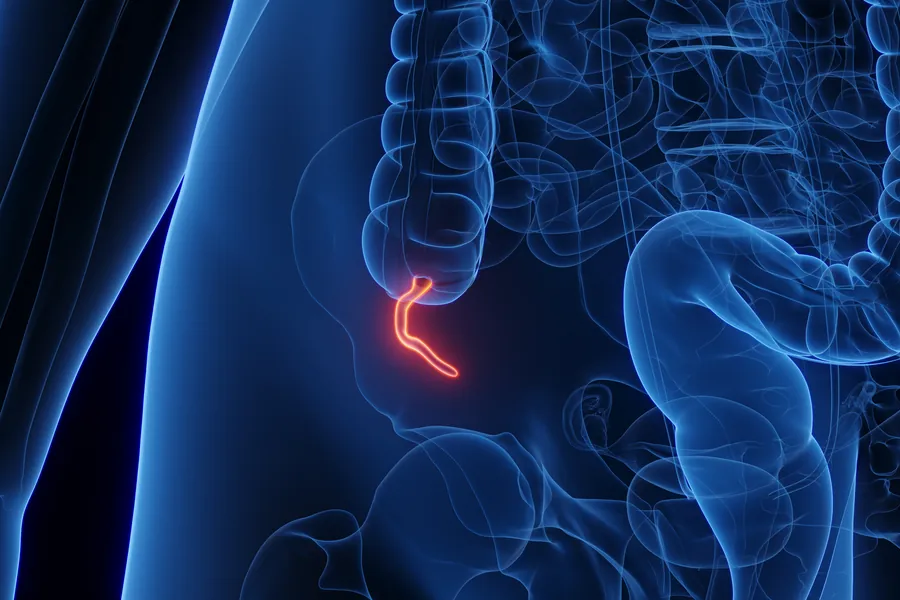 Appendix removal might disrupt the gut microbiome, raising Alzheimer’s risk.“The appendix is thought to act as a reservoir for beneficial gut bacteria, which may help restore microbial balance after disturbances such as infection, antibiotic use, or illness. Over time, disruption of this recovery mechanism could contribute to changes in gut microbial composition.”
“Since the gut microbiome is increasingly recognized as being connected to brain health through immune and metabolic pathways, these long-term alterations may be associated with increased vulnerability to neurodegenerative processes. However, further longitudinal and experimental studies are needed to confirm the biological mechanisms underlying this association.”
Dietary patterns for lowering disease risk
The study found that overall dietary patterns are more predictive than single nutrients — whole food diets cut risk while processed foods raised it.
“The cumulative, daily effect of how a person eats across years and decades is what matters most. Diets rich in plant protein, whole foods, dairy, and omega-3 fatty acids were consistently associated with lower Alzheimer’s risk, while reducing processed foods, refined sugars, and saturated fats,” says Karimi.
“Lactose intake was a particularly striking individual signal, with higher dairy consumption linked to lower predicted risk, possibly reflecting the microbiome’s positive response to fermented foods and calcium’s known neuroprotective properties.”
Potential to protect gut-brain connection
The researchers studied gut microbiome data from participants in the same cohort to better understand the biological mechanisms behind the link between a missing appendix and Alzheimer’s disease.
AI flags early Alzheimer’s patterns from diet, appendix status, and lifestyle factors.They found that people who had their appendix removed had missing beneficial gut bacteria, making short-chain fatty acids.
We ask Karimi whether dietary changes could help protect the gut-brain connection, which he notes to be the most promising implication of his team’s findings.
“The beneficial bacteria depleted in Alzheimer’s patients, those responsible for producing short-chain fatty acids, which maintain the gut’s protective barrier and suppress neuroinflammation, are modifiable. Unlike genetic risk factors, the gut microbiome is responsive to what we eat.”
“Diets high in fermentable fiber, fermented foods, and omega-3 fatty acids have been shown in other research to support the growth of exactly these bacterial communities. While our study does not yet establish that dietary change directly restores this protection in the context of Alzheimer’s specifically, the direction of evidence is encouraging, and this is precisely what longitudinal follow-up studies need to investigate.”
A previous study suggested that people with the highest genetic risk for Alzheimer’s disease benefited more from following a Mediterranean-style diet, showing a greater reduction in related dementia risk compared to those at lower genetic risk.
Other research indicated that the quality and quantity of dietary carbohydrates have a significant impact on dementia development. Meanwhile, obesity was found to raise the risk of Alzheimer’s disease blood markers.
In supplement support, researchers have uncovered how boosting NAD+ may help protect the brain from the degenerative effects of Alzheimer’s disease, while arginine could reduce Alzheimer’s disease markers.
AI tool helps with early detection
The study’s AI model flagged high-risk people early based on combinations of lifestyle, dietary, and medical history factors rather than single variables, explains Karimi. His team believes that the results of their study could also potentially inform an AI framework that could be used as a low-cost community-level screening tool.
“The AI model identifies risk patterns based on combinations of lifestyle, dietary, and medical history factors rather than single variables. This allows for earlier identification of individuals who may be at elevated risk long before clinical symptoms appear.”
“From a practical perspective, modifiable factors such as improving dietary quality, increasing intake of whole and plant-based foods, reducing processed food consumption, and managing cardiovascular health appear to be most relevant.”
Karimi explains that these changes are not posited to be treatments or cures to Alzheimer’s. Rather, they are potentially supportive lifestyle adjustments that align with evidence linking metabolic, inflammatory, and gut health pathways to brain health over time.