



New study finds phages release vitamin B12 by bursting gut bacteria


Key takeaways
- Scientists have found that bacteriophages release trapped vitamin B12 by infecting and exploding vitamin B12-producing gut bacteria.
- Experiments showed that vitamin B12-dependent microbes grow only in the presence of phages that break down vitamin B12-producing bacteria to free the nutrient.
- This discovery suggests that viral phages play an important role in distributing essential nutrients and supporting overall gut microbiome health.

While scientists have long understood how vitamin B12 is absorbed into the body, new research reveals the role of bacteria-eating viral bacteriophages, also called phages, in releasing vitamin B12 from microbes that produce the essential nutrient.
Phages attack bacteria in a process called lysing, where the virus attaches to a bacterial cell, injects its own DNA, and reprograms the host cell to manufacture more phages. When the bacterial cell eventually succumbs to this, it explodes into a flood of new phages.
However, authors of the study detail that this “bacterial death gush” leads to more than just the propagation of new phages — it releases DNA, protein, and sugars from within the bacteria, which are things that the bacterial cell normally hoards so that it can continue to grow.
“In a genetically well-defined system [for vitamin B12 extraction], we can demonstrate that phage is necessary,” says study co-author Bryan Hsu, a biologist at Virginia Tech, US. “The vitamin B12 doesn’t just leak out.”
To investigate whether the findings hold up in a more complex environment, the scientists completed similar experiments on major types of gut bacteria found in the human digestive tract — including Bacteroides fragilis, B. intestinalis, B. ovatus, Clostridium sporogenes, and Escherichia coli Nissle 1917.
They found that microbes dependent on vitamin B12 grew only when a phage lysed a vitamin B12 producer.
Prospecting biological gold
Vitamin B12 is “biological gold,” as the researchers explain, writing in ISME Journal. It is essential for living organisms to form red blood cells and DNA, as well as to build and support brain and nerve cells. However, it can only be produced by certain bacteria and archaea.
Humans obtain the nutrient from natural food sources including meat, shellfish, fish, poultry, and dairy, in addition to supplements.
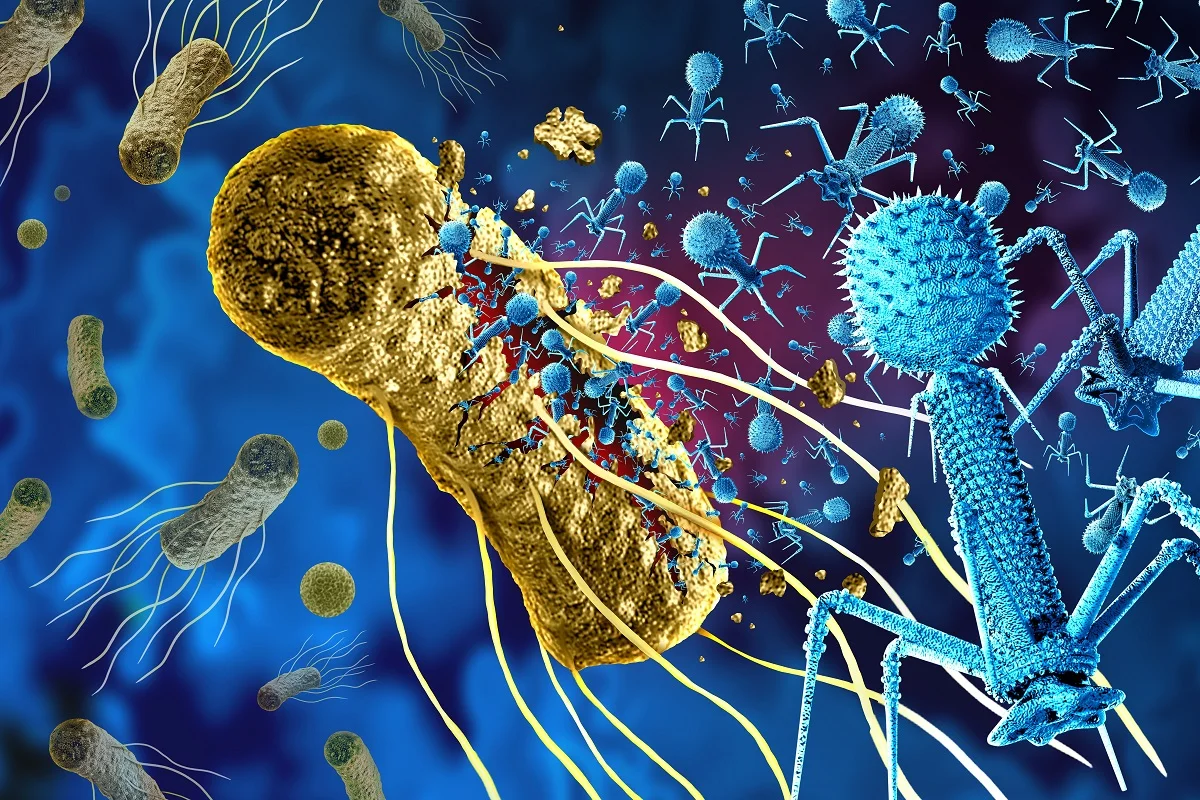 Phages attack bacteria in a process called lysing, which releases their vitamin B12.The paper explains that phage infection is a primary agent for releasing vitamin B12. David da Silva Barreira, the study’s first author and a former Virginia Tech postdoctoral associate, confirmed this by co-culturing a vitamin B12-producing bacteria with a vitamin B12-consuming cell that needs to scavenge for the vitamin from the environment.
When the phage was not introduced, vitamin B12 remained trapped within the intact producer cell, meaning that the consumer did not have access to the vitamin and did not grow.
However, when the scientists unleashed phages to lyse the producer, they noticed the consumer cell began to thrive.
The researchers set out to verify whether vitamin B12 specifically drove the growth boost, rather than other cellular contents. Da Silva Barreira repeated the experiment with a producer strain that was genetically engineered to lack the nutrient.
When phages lysed the modified cell, the researchers observed that the user failed to grow. This proved that vitamin B12 was the essential component, which the authors say is a “first for the field.”
Repeating experiments
Altogether, the findings suggest that the destructive activities of bacteriophages on bacteria play a crucial role in distributing nutrients for human health, promoting microbial diversity, and supporting gut microbiome health.
While phages play a major role when bacteria are lysed to release their nutrient content, the researchers say it is unlikely to be the only mechanism. In their paper, they detail that high-yield vitamin B12 producers such as Propionibacterium acidipropionici and various marine bacteria contain the nutrient in culture supernatants — the liquid medium that remains in a test sample after bacteria are removed.
Discovering vitamin B12 in the supernatant is evidence that the vitamin was floating freely in the liquid outside intact bacteria. This suggests the bacteria are leaking vitamin B12 out into their environment while still alive, rather than only releasing it when they die and burst open.