
Industry embraces EU Organic Roadmap for farmer and consumer well-being

Key takeaways
- The European Commission’s proposed updates to the Organic Regulation aim to align organic farming practices with regional realities.
- Studies show that organic farming benefits farmers’ health and mental well-being, while organic food consumption correlates with healthier diets and lower disease risks.
- Organic agriculture supports up to 3.5 million jobs across the European value chain, promoting rural employment and diversification.
The European Commission (EC) has introduced a Roadmap recognizing the nutritional and socio-economic benefits of organic foods, alongside a proposed amendment of the EU Organic Regulation to enhance transparency.
Reacting to the new Roadmap and proposed amendments, Eduardo Cuoco, director of IFOAM Organics Europe, says: “Defining the practicalities of organic food and farming in a way that fits the different territories and conditions of 27 member states is a complex task.”
“The organic movement welcomes Christophe Hansen’s (European Commissioner for Agriculture and Food) intention to better align the organic regulation with realities on the ground without reopening the principles or lowering the high standards of organic agriculture.”

Cuoco says the regulatory amendments on labeling, certification, and certain rules on trade should ensure that the new definitions enable more stakeholders, such as farmers and operators, to effectively implement the regulations on the ground.
IFOAM Organics Europe shares that the Roadmap and regulatory amendments are a result of new socio-economic evidence presented in the European Parliament (EP). This research increasingly supports that organic agriculture is already delivering concrete benefits for Europe’s “competitiveness, economic security, and rural development.”
Nutrition Insight attended the high-level event at the EP where this evidence was presented. The event was organized by IFOAM Organics Europe, Eat Europe, and Coldiretti Bio, and hosted by MEP Herbert Dorfmann.
Securing consumer and farmer health
During the event titled: “The Socio-Economic Value of Organic Agriculture: Strengthening the Competitiveness of the Value Chain and the Resilience of Rural Areas,” Dorfmann highlighted evidence from large cohort studies conducted by NutriNet-Sante. It revealed that regular organic food consumers have healthier dietary patterns with more plant-based foods and fewer ultra-processed products.
 Data shows organic food consumption reduces the prevalence of overweight, obesity, and certain cancers.“Regular organic food consumers show lower prevalence of overweight, obesity, metabolic syndrome, and certain cancers, with up to 25% risk reduction.”
“For farmers, organic systems mean lower occupational exposure to pesticides and fertilizers, reducing the risk of acute and chronic health effects among farmers. Such agricultural practices are further associated with improved mental well-being among farmers. For example, a 2025 FiBL farmer survey showed 86% linked organic farming with happiness, while 95% expressed pride in organic farming.”
He argued that more organic production can facilitate rural employment, engage younger farmers, and foster diversification.
Driving consumer preference
Dorfmann further said that health and safety concerns are the main drivers of organic purchases. “Organic is perceived as more natural and of higher quality.”
“Organic purchases are more common among younger and middle-aged, urban, and better-educated consumers. Higher-income households buy organics more frequently, but all groups purchase some organic food.”
Positive attitudes to health, environment, and food ethics are described as “strong” predictors of organic buying.
High prices “consistently” constrain the consumption of organic products, alongside limited availability, assortment, and visibility in shops, especially in rural areas.
Regulatory framework needed
Also at the event, Raffaele Zanoli, president of the International Society for Organic Agriculture Research, presented new data on organic agriculture.
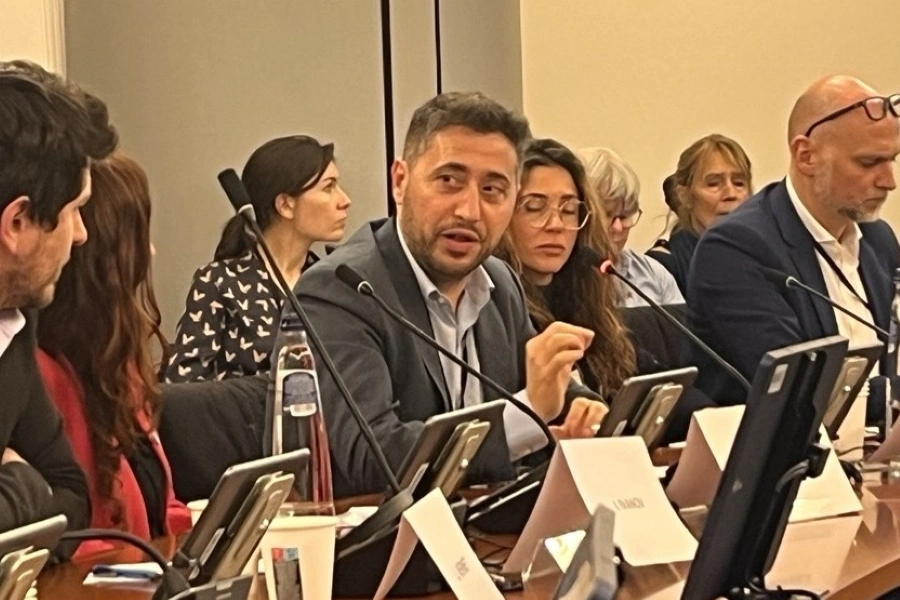 Eduardo Cuoco, director of IFOAM Organics Europe, at the event.“Organic farming generates 150,000–200,000 additional full-time equivalent jobs on farms and 2.5–3.5 million jobs across the European organic value chain and relies 30–40% less on external inputs, reducing farmers’ vulnerability to global fertilizer and pesticide markets.”
“It keeps more processing and value-added activities in rural areas and attracts younger and more diverse operators, while lowering public costs linked to water protection and soil degradation.”
Reacting to these findings, Cuoco said: “The evidence is clear: organic farming is already delivering what Europe says it wants — more competitiveness, more resilience, and more quality jobs in rural areas. The upcoming revision of the Organic Regulation and the new Action Plan must build on this reality, with strong, clear, and coherent rules that protect trust and help organic farmers and SMEs compete on a fair playing field.”
“A stable and predictable regulatory framework is essential for organic farmers and operators across Europe, especially for a sector that has grown steadily over the past years and proven its contribution to resilient food systems and rural development.”
Cuoco concluded: “We look forward to working constructively with the EP and member states to ensure a swift adoption, providing legal certainty and continuity for the organic sector. The EC targeted approach is the right way forward to consolidate the achievements of organic farming in Europe while enabling further development.”