



NSF and Non-GMO Project roll out Non-UPF certification amid ultra-processed food backlash


Key takeaways
- NSF is the technical administrator for the Non-GMO Project’s “Non-UPF Verified” seal, auditing ingredients and industrial processing methods.
- To earn the certification, brands must eliminate engineered additives and non-nutritive sweeteners while keeping refined sugars and oils below a 30% threshold.
- Spindrift Beverage has become the first brand to receive the seal, signaling the company’s shift toward using processing transparency as a competitive advantage.

Industry discussions in the US around tightening federal policy on highly processed foods are heating up, and the public health and safety organization NSF has now begun certifying products under the newly introduced Non-Ultraprocessed Foods (UPF) Verified program spearheaded by the Non-GMO Project.
The certification scheme follows recent updates to national dietary guidance strongly advising consumers to consume less highly processed foods as a broad category. Globally, governments are shifting from advising against UPFs to actively cracking down on them through taxation, mandatory labeling, and school bans.
Nutrition Insight speaks to Carey Allen, director of Food Claims at NSF, to examine what impact this could have for the industry at large. She details how a “Non-UPF” label would clarify what qualifies as an UPF — particularly for nutritional products that require some level of processing, such as those formulated with functional health ingredients.
“The Non-UPF Verified program offers much-needed clarity to consumers and retailers alike. The verification focuses on how a food is made and what goes into it.”
“Nutritionally positioned products, such as functional foods, are acceptable if the products are composed primarily of minimally processed ingredients,” she notes. “Functional ingredients that undergo additional processing are permitted as long as they are not produced using prohibited processing methods.”
How the certification works
By the program’s definition, not all processing methods are ranked equal. It distinguishes between minimal, conditional, and prohibited processing methods, requiring that products be composed primarily of minimally processed ingredients and free from high-impact chemical, structural, thermal and biological modification.
 Prohibited methods include industrial techniques that break down or chemically alter food, such as high-intensity chemical solvent extraction, hydrogenation, and the isolation of fibers.Permissible methods include traditional mechanical and thermal processes that preserve the food’s natural structure, such as milling, cold-pressing, pasteurization, freezing, and natural fermentation.
Conversely, prohibited methods include industrial techniques that break down or chemically alter food, specifically high-intensity chemical solvent extraction, hydrogenation, and the isolation of proteins or fibers.
As a technical administrator, NSF conducts independent evaluations, ensuring that Non-UPF Verified products meet the program’s criteria in “ingredient integrity” and processing limits.
Non-UPF Verified certification involves several steps, including discovery and scoping, technical submission, independent evaluation, verification decision, and ongoing change control. Verified food and beverage products may display the Non-UPF Verified mark on packaging.
“By reviewing product ingredient decks, processing flowcharts, and supplier inputs, Non-UPF verified recognizes products that are thoughtfully formulated and transparent,” says Allen.
Typical barriers for brands
From a technical standpoint, Allen discusses aspects of formulation or processing that tend to be the most difficult for brands to align with Non-UPF Verified criteria.
“The first is engineered additives, which are legacy formulations that may rely on additives that will need to be replaced with suitable alternatives that maintain texture, shelf life, and sensory quality,” she details.
“Another barrier is refined sugars and refined oils in excess of the 30% limit in the product formulas. In addition, with the program’s added sugar thresholds by category and ban on non-nutritive sweeteners, brands must face reformulation to meet taste and program requirements.”
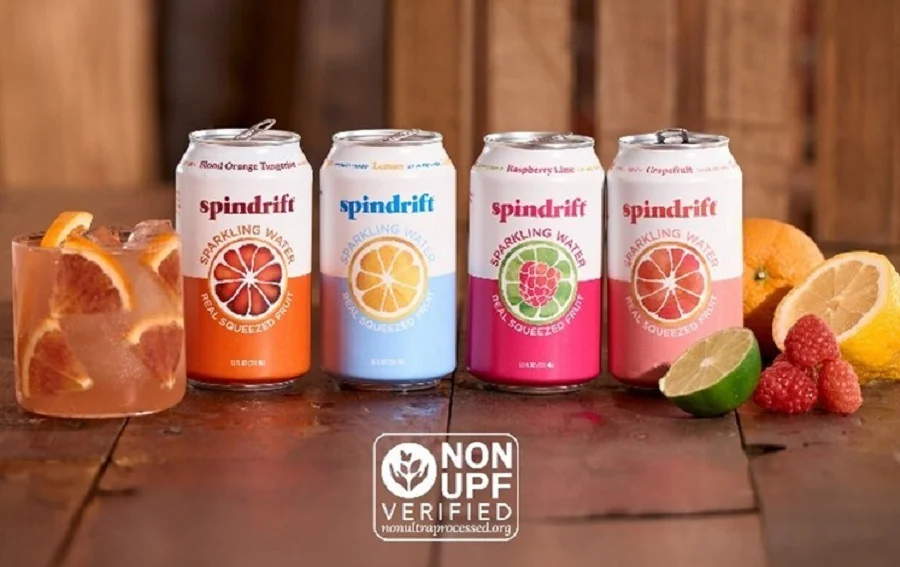 Spindrift Beverage is the first brand to be certified with the Non-UPF Verified label (Image credit: NSF).She adds that NSF’s technical reviewers work with brands to align product lists, categories, and target timelines. This process includes finding gaps and areas for adjustment in preparing for verification.
“Our hope is that as a technical administrator, we can support any brand seeking independent verification of the standard,” says Allen. “We’re a global human health organization and have the capabilities and talent to review products from around the world being exported to the US.”
First brand to be certified
Spindrift Beverage was recently the first company to be certified under NFS’s Non-UPF Verified label. The sparkling water brand will soon roll out the seal across its website, digital channels, and beverage packaging.
“This verification gives consumers a clear, credible validation in a category that’s become increasingly confusing, where many beverages rely on artificial ingredients, sweeteners, and unnecessary processing,” says Dave Burwick, CEO of Spindrift. “Non-UPF Verified reinforces that philosophy and helps make our approach easier to recognize on the shelf.”
Critics of the pushback against UPFs have been outspoken about the enormous weight certain guidelines place on the Nova classification system, which sorts foods by the extent of industrial processing rather than by nutritional value — how foods impact blood sugar, insulin, weight gain, and long-term metabolic function.
Food industry representatives ACI Group and Specialised Nutrition Europe have also argued that food processing as a whole is not inherently “bad” and often essential to improve access to nutrition. As a workaround solution, they underscore the importance of reformulating with natural functional equivalents and propelling the shift toward cleaner technology processing systems.